On November 10, the Roman Catholic Church observes the feast day of St. Leo the Great, Pope and Doctor of the Church. Leo's earthly life ended on that date in 461. Butler's Lives of the Saints states that in his writings (including 96 genuine sermons and 143 letters), Leo emphasized "alms-giving and other social aspects of Christian life, as well as expounding Catholic doctrines—especially that of the Incarnation."
While little is known about Leo's early life, it is evident from his writings that he received an excellent education. Leo served as a deacon under the saintly popes Celestine I and Sixtus III. When Sixtus died, Leo was serving in Gaul. It was there he was notified that he had been elected as the successor to St. Peter.
During his pontificate, Pope Leo the Great battled various heresies, including Pelagianism, Nestorianism, and Eutychianism (named for the abbot Eutyches, who denied the proper distinction of Christ’s two natures). He poured out his energies in instructing the Christians of Rome, hoping to make the Roman Church an exemplar for the rest of the universal Church.
Not only did Pope Leo bring clarity to the orthodox teachings of Christianity, but he also facilitated peace in various civil matters. Most notably, he is remembered as the Pope who met Attila the Hun when the invader threatened Rome. After the encounter, Attila withdrew without entering the Eternal City.
Today, Leo's legacy lives on in different ways. The Leonine Forum, for example, is a Catholic leadership and formation initiative that derives its name from two amazing Leos: Pope St. Leo the Great and Pope Leo XIII (who helped formalize Catholic social teaching). In another sense, Leo the Great's legacy trickles down through all the subsequent Popes who also took the name "Leo," including the Chicagoan who became Pope Leo XIV.
Most importantly, he bequeathed to all future generations of Catholics his writings, which convey the truths of the faith in vibrant clarity. Let us take a look at some of his key contributions to theology.
The Hypostatic Union
Leo passionately defended the hypostatic union: the union of the divine and human natures in the one person, or hypostasis, of Jesus Christ. As the New Catholic Encyclopedia explains, “Jesus Christ is both God and man in virtue of the hypostatic union, a mystery of faith in the strict sense.”
In the fifth century, Eutyches tried to answer Nestorianism but moved toward an opposite error. Nestorian thought resisted calling the Virgin Mary the Theotokos, or “God-bearer,” regarding her instead as only the mother of Christ’s human nature. Taken to its logical conclusion, this view suggested that God did not truly become man but merely dwelt within the man Jesus. It thus divided Christ into two persons, meaning that the Second Person of the Trinity did not truly become man or truly redeem us.
Eutyches fell into a different error. He held that Christ had two distinct natures before the Incarnation, but only one nature afterward. Such thinking does away with the supposed complex of Christ's dual personalities, but then it eliminates the proper distinction between the two natures of Christ. Orthodox teaching holds that, from all eternity, God exists as pure spirit. At the instant the Incarnation begins, with the conception of Jesus in the womb of the Virgin Mary, God the Son takes on our human nature, without losing the fullness of his divinity. This possession of two natures by Christ is called the grace (or gift) of the hypostatic union.
Eutyches professed an understanding contrary to this. Leo the Great responded to such errors in a letter he wrote to St. Flavian in 449. Today, this letter is alternately called the "Tome to Flavian," "The Tome of St. Leo," or quite simply "The Tome." It is a concise piece of correspondence that rebukes Eutyches's mode of thinking and sets the record straight about the Incarnation.
In "The Tome," Leo reiterates to Flavian how the twofold nature of Jesus Christ remains one of the most rudimentary tenets of the Catholic faith. He writes that Eutyches
might at least have listened attentively to that general and uniform confession, whereby the whole body of the faithful confess that they believe in God the Father Almighty, and in Jesus Christ, His only Son, our Lord, who was born of the Holy Spirit and the Virgin Mary. By which three statements the devices of almost all heretics are overthrown.
As Leo notes, the language of the Nicene Creed is sufficient to illustrate Eutyches's errors. He continues his argument and eloquently illustrates the extraordinary virtue of God's condescension to man and the necessity of Christ's two natures functioning toward the salvation of humanity:
Without detriment therefore to the properties of either nature and substance which then came together in one person, majesty took on humility, strength weakness, eternity mortality: and for the paying off of the debt belonging to our condition inviolable nature was united with possible nature, so that, as suited the needs of our case, one and the same Mediator between God and men, the Man Christ Jesus, could both die with the one and not die with the other.
Liturgy and the Lives of the Faithful
As we have discussed on the blog before, the Church sees a clear continuity between her liturgy and the lives of the faithful in the world, with the one imbuing the other with fruitfulness. In a Wednesday audience in 2008, Pope Benedict XVI lauded the teachings of Pope Leo the Great about the Mass and associated devotional practices:
[Leo the Great] enlivened charity in a Rome tried by famines, an influx of refugees, injustice and poverty. He opposed pagan superstitions and the actions of Manichaean groups. He associated the liturgy with the daily life of Christians: for example, by combining the practice of fasting with charity and almsgiving above all on the occasion of the Quattro tempora, which in the course of the year marked the change of seasons. In particular, Leo the Great taught his faithful - and his words still apply for us today - that the Christian liturgy is not the memory of past events, but the actualization of invisible realities which act in the lives of each one of us.
The Sacrifice of the Mass is a re-presentation of Christ's self-same Sacrifice on Calvary. In the sacred liturgy, the God who exists outside of time makes present to the faithful the most significant moment of time, that of our salvation. For us to participate in the Mass is to partake of that same Sacrifice. It is a past event made present to us in the here and now, in which the Sacrifice is alive and effective just as it was 2,000 years ago.
Pope Benedict XVI expresses the reality of the past made present at Mass by expounding on the nature of Christ's Sacrifice as being done "once for all" (Heb 7:27). In The Spirit of the Liturgy, he writes:
"Today" embraces the whole time of the Church. And so in the Christian liturgy we not only receive something from the past but become contemporaries with what lies at the foundation of that liturgy. Here is the real heart and true grandeur of the celebration of the Eucharist, which is more, much more than a meal. In the Eucharist we are caught up and made contemporary with the Paschal Mystery of Christ, in his passing from the tabernacle of the transitory to the presence and sight of God.
Christ's past Sacrifice is made present to us. He has something beneficial to offer us right now. Through this self-same Sacrifice, which we experience in the Mass, we can go out into the world glorifying the Lord by our lives. Liturgy influences life. It convicts us to act in accord with God's justice. Leo the Great understood this just as Benedict XVI did. Christian spirituality naturally spills over into our concrete activity.
Charity for the Poor
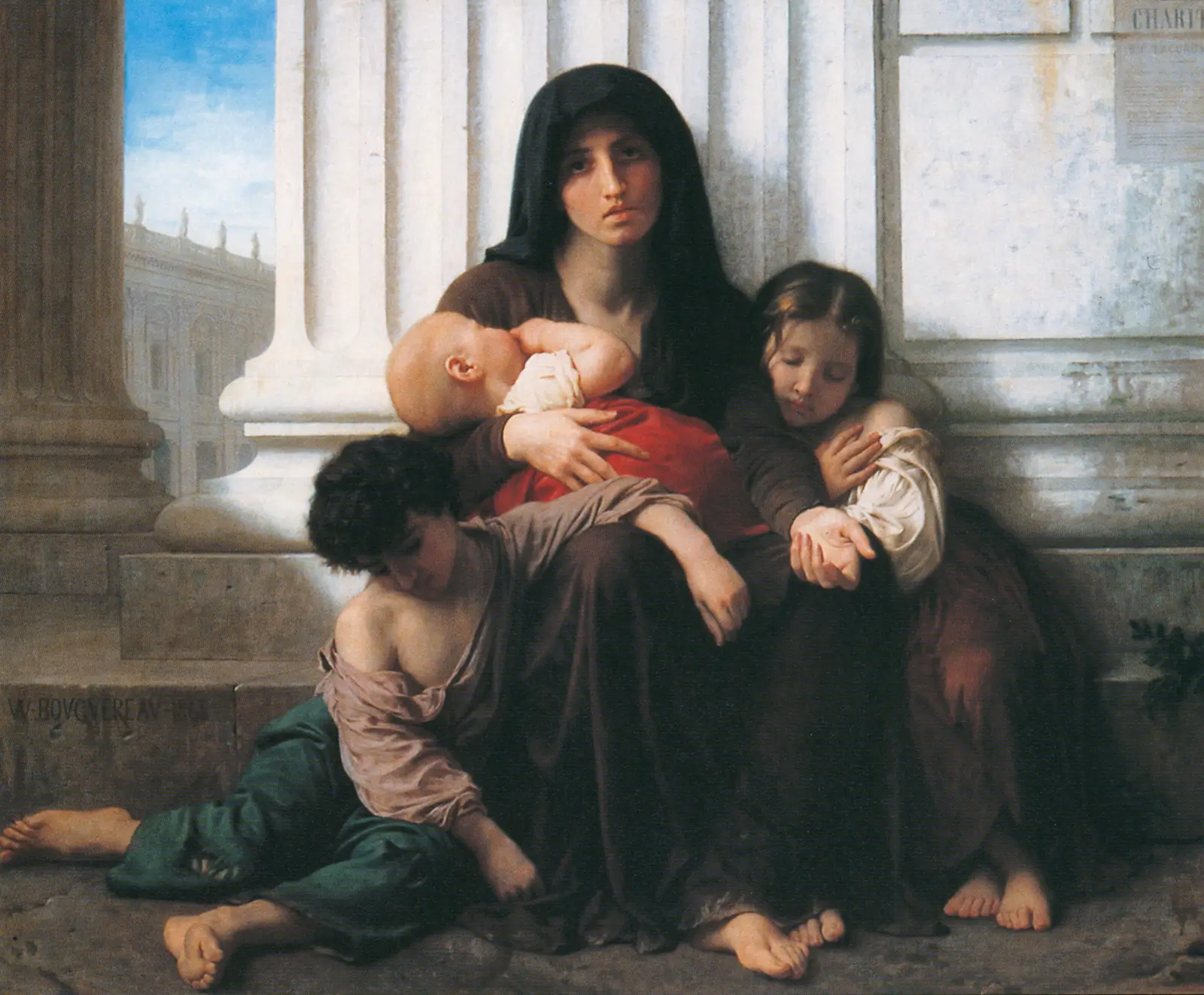
As noted above, an outstanding mark of Leo the Great's service to the Church was his service to the poor. Regarding charity toward the downtrodden and indigent of society, Leo wrote:
Inasmuch as the sacred usefulness of [deeds of mercy] affects not only time past but also our own age, so that what aided [the Apostles] in the destruction of vanities, might contribute with us to the increase of virtues. And what so suitable to faith, what so much in harmony with godliness as to assist the poverty of the needy, to undertake the care of the weak, to succour the needs of the brethren, and to remember one's own condition in the toils of others.
The Christian, Leo affirms, is not meant to think only of himself but to empathize with others, recognizing that others suffer just as he might suffer. As we might wish those around us to have compassion on us in our afflictions, so we should express charity toward those who are not well off.
"Wealth," writes Leo, " is good and is of the greatest advantage to human society, when it is in the hands of the benevolent and open-handed." Riches then have their greatest value not in what they can do for me, but in what they can do for others in need.
As it turns out, what were priorities for Leo the Great 1,500 years ago remain priorities for us also: the truth of who Jesus Christ is, the influential place held by the sacred liturgy, and the care given to the vulnerable and less fortunate. St. Leo the Great was the Pope the Church needed in the 5th century, a strong voice to correct error and respond to injustice with love. If Leo the Great was not a saint of our time, he is certainly a saint for our time.


Indigent Family by William-Adolphe Bouguereau.