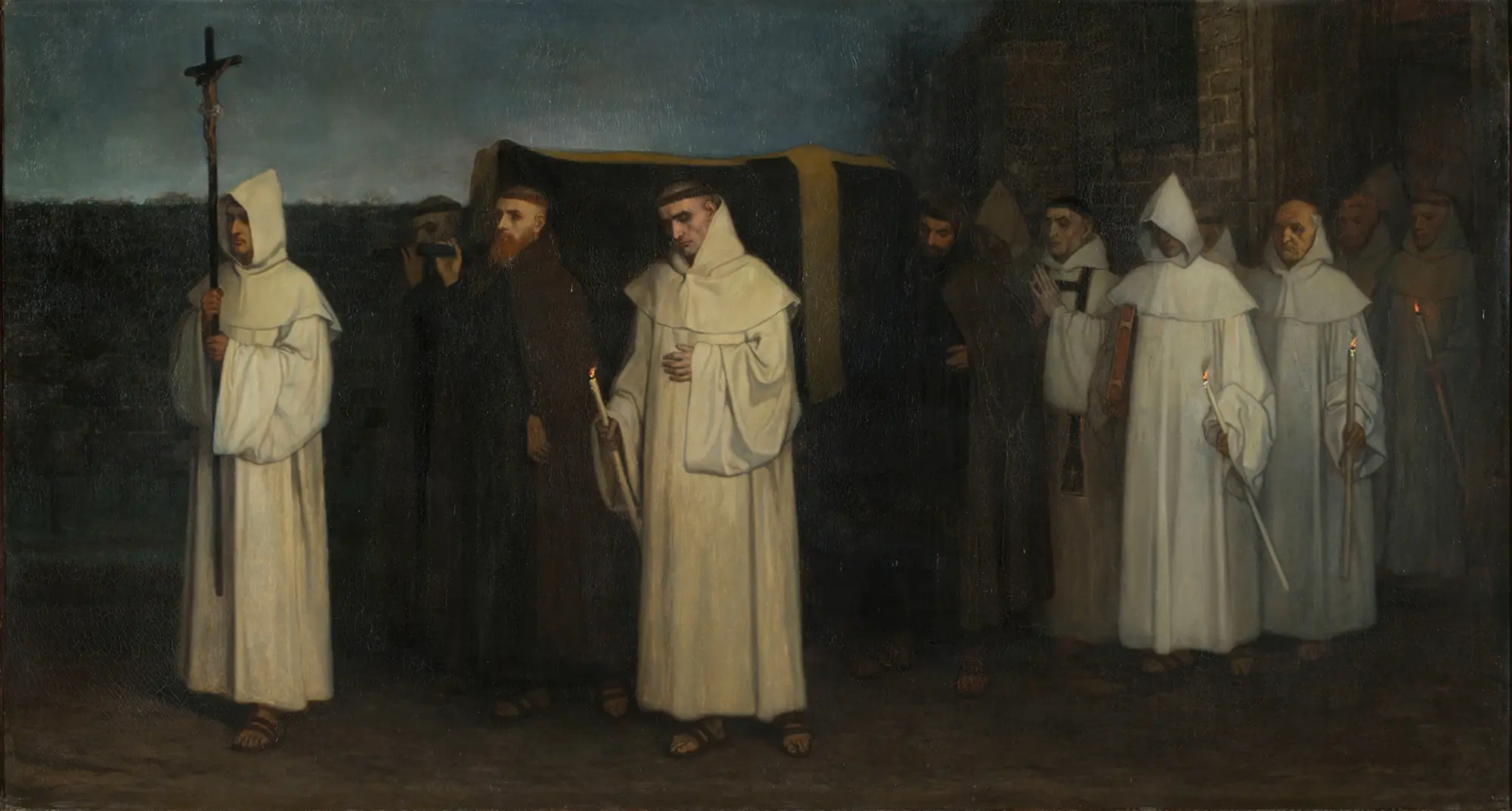
Next week begins the month of November, in which we recall and pray for the holy souls in Purgatory. This practice is rooted in Christian charity and extends back even before the time of Jesus (cf. 2 Mc 12:42-46). We pray for our brothers and sisters, asking God that their journey through Purgatory be swift and that they may all the sooner enter into the beatific vision of our Lord forever. With such an important task, it is no wonder that many programs and methods have been developed over the centuries to help give a structure to these acts of love. One such program is the Office of the Dead.
Originating as a purely devotional set of prayers for the laity, it was soon incorporated into the medieval iterations of the Liturgy of the Hours. Once incorporated it was mandated to be said by the clergy on regular days throughout the year while remaining a popular devotion among the laity. With the development of the Liturgy of the Hours, there also came a new form of the Office of the Dead. This modern iteration is to be said by all clergy on the Commemoration of All the Faithful Departed (All Souls’ Day, November 2) but is also permitted to be said on virtually any day for a specific person. These prayers focus on the certainty of death and judgment alongside the mercy of God and his conquering over the grave. These prayers, then, are beneficial not only to those for whom we pray but for us as well. By remembering the fate that the deceased have come to and that we will come to in time, we are drawn closer to one another and, ultimately, to Christ Jesus our Lord.
Invitatory and Office of Readings
The Invitatory, which ought to begin the first hour said in a day regardless of which it is, frames one of the most important reflections on death with its Antiphon:
Come, let us worship the Lord, all things live for him.
God has given life and it is his to receive back. We live for him and thus, in a certain sense, die for him as well. It reflects the same sentiment as, “Fear not, I am the first and the last, and the living one; I died, and behold I am alive for evermore, and I have the keys of Death and Hades” (Rev 1:17-18).
This same idea is broken open further in one of the options for the Second Reading of the Office of Readings. St. Braulio writes:
We do not really belong to ourselves; we belong to the One who redeemed us.
From these two parts of the Office of the Dead, we are immediately forced to recognize that we are only stewards of our life and our time. One day we shall have to give an account of that time, praising God for the good we did and asking forgiveness for our failures.
Morning Prayer
In this hour we confess more pointedly how God redeems us in the Intercessions:
Father, through baptism we have been buried with your Son and have risen with him in his resurrection,
—grant that we may walk in newness of life so that when we die, we may live with Christ for ever.Provident Father, you have given us the living bread that has come down from heaven and which should always be eaten worthily,
—grant that we may eat this bread worthily and be raised up to eternal life on that last day.
It is through the Sacraments, those extensions of Christ’s earthly ministry, that we are brought to everlasting life. These Sacraments are received bodily, and so we are also reminded here that those who have died in Christ will truly receive their bodies back on the last day unto the glory of eternal life.
Daytime Prayer
Meant to be a short break for prayer in the middle of the day, the selections made for this hour come straight to the point. Particularly poignant are the short readings, like Midafternoon’s Isaiah 25:8:
God will destroy death forever;
the Lord will wipe away
the tears from all faces;
The reproach of his people he will remove
from the whole of the earth;
for the Lord has spoken.
Even amidst the sorrows of death, we recall the consolation that we will have one day in the vision of God in his glory and that we partially possess even now by hope.
Evening Prayer
With the day coming to a close, this hour makes sure at several points to remind us why we are praying so fervently for the dead. As in one of the Antiphons:
If you kept a record of our sins, Lord, who could escape condemnation?
And in the Intercessions:
Christ, Savior, destroy the reign of sin in our earthly bodies, so that just as through sin we deserved punishment,
—so through you we may gain eternal life.
These beloved dead were also sinners (as are we) and so stand in tremendous need of mercy and healing. We bring this prayer boldly before the throne of grace (cf. Heb 4:16) in the confidence that whenever we repent earnestly, we shall surely find forgiveness.
Night Prayer
We end this program with the prayers said, not on that day of the week nor on the penitential Friday, but with those of Sunday. We come to the Book of Revelation and offer God his own description of the eternal destiny of those who die in faith from the fourth and fifth verses of chapter 22:
They shall see the Lord face to face and bear his name on their foreheads. The night shall be no more. They will need no light from lamps or the sun, for the Lord God shall give them light, and they shall reign forever.
In the life of Heaven, each day is the day of the Resurrection. In praying we recall that those in Purgatory have not yet received this in its fullness, but we also know that God, who can neither deceive nor be deceived, will bring them to that glorious city. Let us pray that they make it there soon and that we might join them in praising the Lamb of God without end.

Sam Landon
Sam Landon is an Associate Editor at Midwest Theological Forum. He holds a master’s in religious studies specializing in New Testament and early Christianity from the University of Chicago. He has worked extensively in campus ministry to help young adults grow closer to Christ. He and his wife live in Chicago, IL.
Funeral of a Trappist Monk by Constantin Meunier.