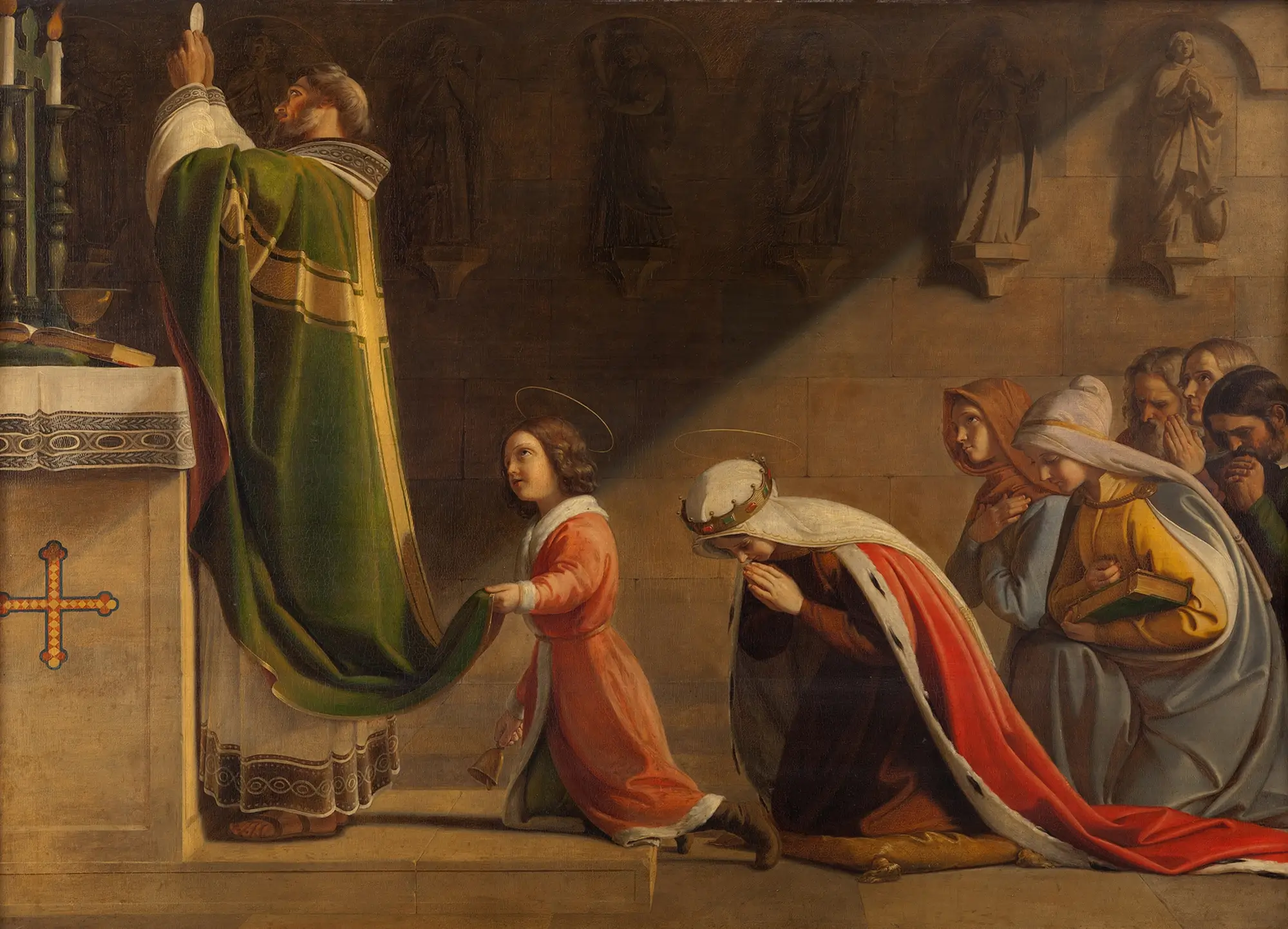
Since May 2026, Pope Leo XIV has highlighted the importance of the sacred liturgy by presenting a series of catechetical discussions on Sacrosanctum Concilium, a key document produced at the Second Vatican Council.
Sacrosanctum Concilium, or “The Constitution on the Sacred Liturgy,” expresses how revered and invaluable the liturgy is to the life of the Church. In all reality, it is the summit towards which all the Church’s activities are directed and the source from which flows the powers bestowed on her by Christ. This only makes sense when we recognize the Mass for what it is—the re-actualization of the Paschal Mystery: the passion, death, resurrection, and glorification of Jesus Christ.
For us Christians living in the twenty-first century, the Mass allows us to enter into kairos, a sacred time set apart, in which we enter into Christ’s same sacrifice offered two millennia ago at the Last Supper and on the altar of the Cross. What is more, if the liturgy is the pinnacle which the Church’s actions are geared toward as well as “the font from which all her power flows” (10) as Sacrosanctum Concilium states, then the proposition that aspects of human society can influence the liturgy (especially on a local level), and vice versa, makes sense. In other words, what the members of Christ’s Body, the Church, contribute at Mass will shape the liturgy to a degree; the Mass, in turn, through God’s contribution—his outpouring of grace—shapes Christ’s members. Let us take a look at the latter, at how the Mass forms disciples of Christ to be laborers in the fields of our society.
The Liturgy’s
Social Dynamic
Many throughout the history of the Church have pointed to this fact, especially in the wake of the social upheaval experienced in our world over the past century and a half. To begin with, the Church always promotes unity within a community and between different peoples. She also promotes the social or communal dimension of her liturgical prayer, particularly in the form of the Mass and the Liturgy of the Hours.
As expressed in Sacrosanctum Concilium:
It is to be stressed that whenever rites, according to their specific nature, make provision for communal celebration involving the presence and active participation of the faithful, this way of celebrating them is to be preferred, so far as possible, to a celebration that is individual and quasi-private.
This applies with especial force to the celebration of Mass and the administration of the sacraments, even though every Mass has of itself a public and social nature. (27)
Christians grow in community. We learn by the good example of others whose lives God has touched. Even more importantly, we are joined together through the person of Jesus Christ. By virtue of Baptism, we belong to his Body, the Church. This belief is rooted in Scripture. Our Lord Jesus himself says, “I am the vine, you are the branches. He who abides in me, and I in him, he it is that bears much fruit, for apart from me you can do nothing” (Jn 15:5). Note that John chapters 14–17 take place within the context of the Last Supper, which served as the inaugural Mass of Christ the High Priest. Jesus is talking about remaining in him on the occasion of the first Mass, which becomes our source of union with him.
If we are joined to the Body of Christ, we are connected to all of his members (cf. 1 Cor 12:27). The liturgy then is a communion with Jesus and with our fellow Christians.
Social and Unitive Aspects
of the Body of Christ
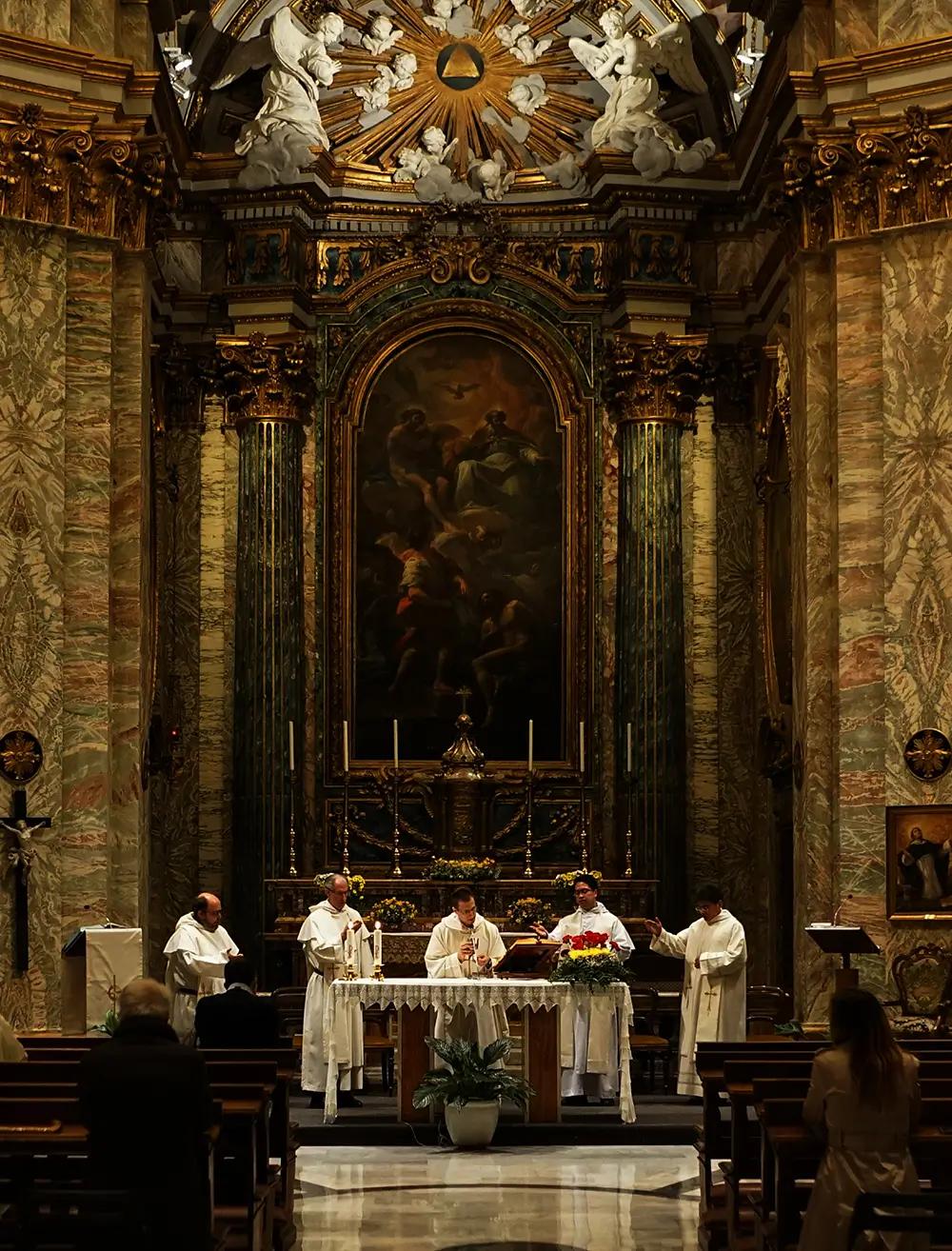 Within the Body of Christ, we recognize our unity (we are all in the same boat, the Barque of Peter) while also acknowledging our diversity—the different gifts designated to each of us by the Holy Spirit being one way in which we stand out among our brothers and sisters. The Christian view knows that the human person is simultaneously an individual personality and a social creature.
Meanwhile, there are secular forces at play that run contrary to the social and unitive characteristics of the Church. Popes have rightly condemned modernist positions such as self-centered individualism and dismissive, totalitarian collectivism. Individualism attacks the unity of the Body of Christ, while collectivism negates the inherent value of the individual as a unique and unrepeatable child of God.
But how can the faithful respond to such political pitfalls? How can her prayer and action change the wider culture for the better? The answer: liturgy! This is the necessary starting point.
Decades before Vatican II, that is what liturgical reformer Dom Virgil Michel, O.S.B. contended: The Mass has the potential to ignite social reform. Just as the Mass can be influenced by society—cultural music being woven into a specific liturgy, for example (SC 119)—so can the liturgy inform human actions beyond the kairos.
Dom Michel reminds us that our good actions are only made possible through Jesus Christ, as our Lord himself told us (see Jn 15:5 above). The merits of Christ are made available to all the members of his Body. “This is the highest type of Christian solidarity—a supernatural living solidarity or fellowship—not only in theory but also in practice,” writes Dom Michel. He goes on to say:
Similarly the liturgy of the Church not only makes and keeps us members of this fellowship, but it always puts the idea of fellowship in Christ into full practice. Just in so far as we participate in the liturgy after the mind of Christ do we also live and breathe this supernatural social unity of all members in Christ. This is why the liturgy is so truly the primary and indispensable source of the true Christian spirit: it not only teaches us what this spirit is but also has us live this spirit in all its enactments. In the liturgy the teaching is inseparable from the putting into practice.
This function of the liturgy could be described as sacramental. A Sacrament is an external sign that makes present what it signifies. As Dom Michel explained, the social dimension of liturgy is not only spoken about but fully lived out “in all its enactments.” To use a common if somewhat crude expression, the Church not only talks the talk but walks the walk. She practices what she preaches. Her prayers and actions go together.
As Pope Leo XIV put it in one of his catechetical addresses on Sacrosanctum Concilium, “The Church’s worship has thus been embodied in the cultural forms of each age and has been able to influence them and even transform them. The liturgy has thus been, for centuries, a driving force for evangelization.” The Mass, as the action of Christ and his members, affects a change in us for the better. Thus changed, we can carry Christ’s grace out to the world, acting as his hands and feet.
The liturgy embodies and thereby fosters unity among all God’s children. The human actions within the Mass are one path that can lead to such unity. Pope Leo describes “exchanging the sign of peace” as a practical symbol within the liturgy. It can, in its truest meaning, inculcate acceptance and benevolence, helping us to recognize that we are not solitary Christians but people called by Christ to care for one another.
Another example given by Dom Michel almost a century ago was “the Offertory procession that was a universal custom of the Church for many centuries” and which was already diminished by the time in which he was writing. In this regard, he looks to the ancient mentality of the early Christians. In the Offertory procession, everyone in the community offered something he had—a product of his labors that would also represent himself—to God. The items offered by each of the members of Christ’s Body were also employed in corporal works of mercy aiding the less fortunate. These offerings served both as gifts to God and provisions for the poor.
This is one tangible mode by which the liturgy historically gave glory to God while also improving the community in assisting with its needs. God’s goodness experienced in the Mass is contagious; it sparks our thirst for the common good of society. This same living tradition has manifested itself in various ways over time in the organic development of our liturgy.
Yet another manner in which the rite of the liturgy shapes us, and one far superior to human action, is the Eucharistic celebration.
How Jesus Changes Us
through the Eucharist
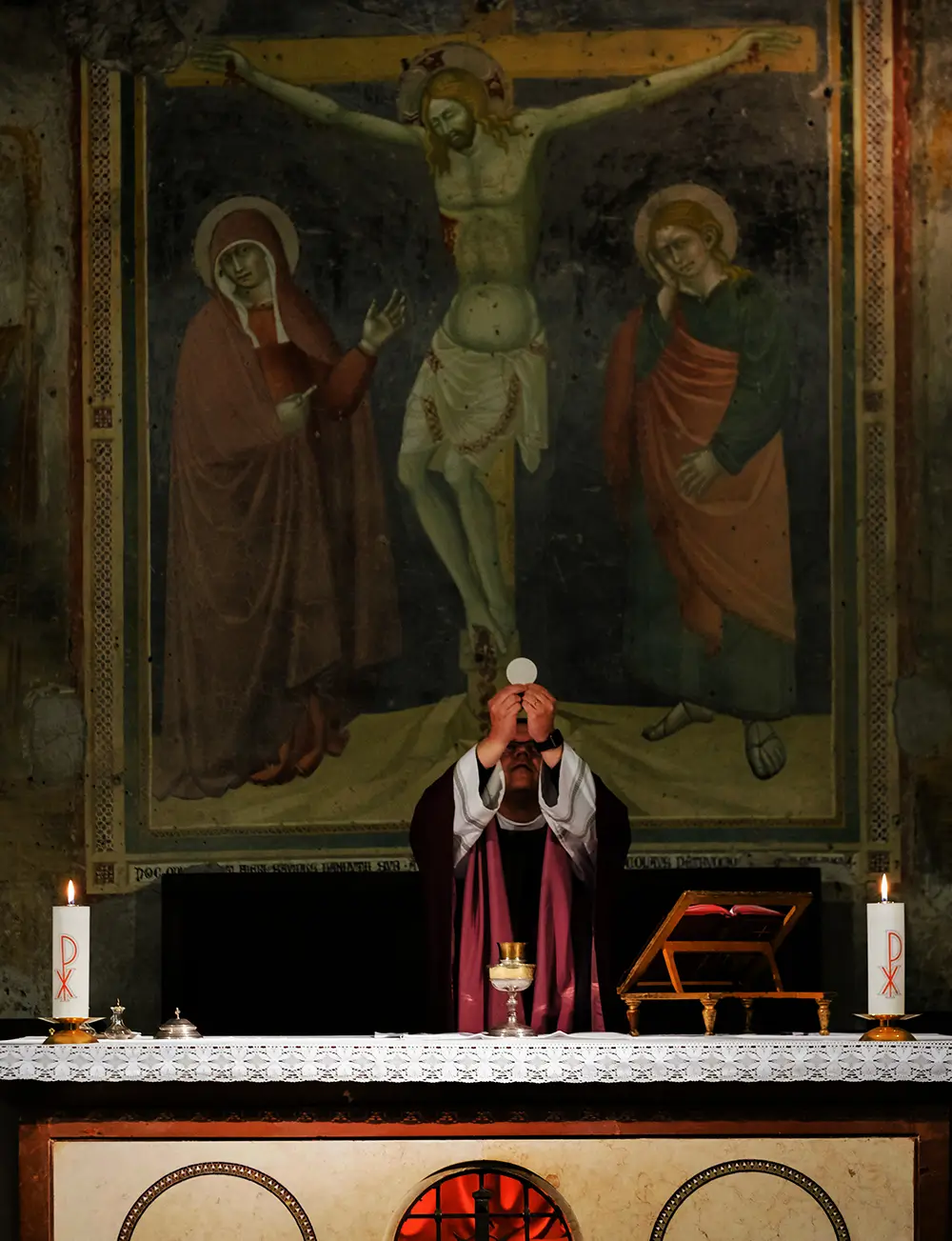 “The sacrament of the Eucharist, holy Communion, is called by St. Thomas [Aquinas] the sacrament of the unity of the Mystical Body of Christ,” writes Dom Michel. He continues this train of thought by examining the reciprocal gift of self on the part of the faithful to God, and on the part of Christ to those participating in the liturgy.
While the most sacred part of the Mass is the Consecration, the height of self-giving both for the individual and for our Lord is the moment of Holy Communion. In this moment, we are united with Jesus, who is perfect Love. He gives us himself and holds nothing back. We, in turn, are invited to likewise give of ourselves unsparingly. If we have received without paying anything, we are also called to give without counting the cost (cf. Mt 10:8).
In one of his audiences, while illuminating the treasures of wisdom found in Sacrosanctum Concilium, Pope Leo said that “by incorporating us into Christ, the Eucharist teaches us to adopt the very style of life of the Lord Jesus, which was marked by the free gift of Himself. This gift draws us into the dynamic of unity, offering a powerful antidote to the forces of division that undermine our world, our communities, our families, and our hearts (cf. SC 47).”
We can counter divisions between ourselves and others, and between other groups of people, with the unity we first experience in the liturgy and the deep love given to us in the Eucharist.
Quoting the same section of Sacrosanctum Concilium as that referenced directly above, Pope Leo reiterated that what Christ bestows on us in the Mass is “a sacrament of love, a sign of unity, a bond of charity, a paschal banquet in which Christ is eaten, the mind is filled with grace, and a pledge of future glory is given to us.”
With God the Son, whom we receive in Communion, comes his grace. God’s grace is transformative. After being baptized and taken up into his Body spiritually, even more so when we receive his Body substantially, we are people who have undergone a change. We no longer live for ourselves but for God and others. We are then ready, when we hear Ite, missa est—or else “Go in peace, glorifying the Lord by your life” or some similar dismissal—to bring Christ out into all the world. Remaining in him, we bear abundant fruit.
Christopher Dawson, the most celebrated Catholic historian of the twentieth century, sheds light on how the mystical order impacts the social order. He says:
The Mystical Body is the link between the liturgy and sociology: and in proportion as men are brought to realize, through the liturgy, their position as members of that Body, will their actions in the social sphere be affected thereby. . . . A visible manifestation of incorporation into Christ, a visible united action on the part of the members, cannot fail to revive and foster in them a determination to carry their Christ-life into the social and economic sphere.
If we want the world to change for the better, we have to first be willing to change ourselves. And that starts by being attuned to God’s Will, whose ways and thoughts far transcend our own limited understanding of things (cf. Is 55:8). Shaped by God’s Word and sustained by Christ’s Body, we can calmly yet boldly respond to human rights violations, to every breed and hue of injustice, and instead build up the Kingdom of God, striving for the common good in our words and deeds.
John Tuttle
John Tuttle is an editorial assistant at Midwest Theological Forum. He has worked as a diocesan communicator, teacher, and reporter. His writing has been published by Catholic World Report, The Wanderer, The Observer, Boone County Journal, Starting Points Journal, University Bookman, Jesuit Media Lab, VoegelinView, and other outlets. He and his family live in northern Illinois.

Artwork: St. Wenceslas and St. Ludmila During the Mass by František Tkadlík.