The young American Catholic poet, Mattie Stepanek, once penned the following lines:
The people who like poetry are probably
The ones who really like life,
And who know how to celebrate
Even when things are sad or happy.
We remember that sometimes,
Even if we don’t understand why,
That the rain falls for a reason.
The saints are men and women who often encounter significant sorrows and struggles in their earthly lives, whether through the loss of loved ones, personal health complications, or spiritual desolation. But how they respond to suffering makes all the difference. A saint can willingly accept his cross and the help of Jesus in carrying it and still find life worth living. Sometimes such a positive outlook on life can seem like a miracle in itself.
One man well-acquainted with pain and grief was Karol Wojtyla, who would one day become Pope John Paul II and later be recognized for his sanctity after his passing from this life. Despite having lost both his parents by age 20 and witnessing firsthand the atrocities of oppressive regimes in his home country of Poland, Karol sought to live life fully.
In Story of a Soul, St. Therese of Lisieux wrote that, “To limit your desires and your hopes is to misunderstand God’s infinite goodness!” Karol limited neither his desires nor his interests. Throughout his life, he pursued many fields of human knowledge and appreciated the most authentic of human experiences.
Karol displayed a passion for creativity early on. Before entering seminary, he studied literature at Jagellonian University in Krakow, while also exploring the dramatic arts. With his love of drama coupled with his love of language, it is nosurprise that he took the time to translate Sophocles’s Oedipus Rex from Greek into Polish. At Jagellonian University, he started to write plays and continued to do so throughout his life. Perhaps the best-known of his plays, The Jeweler’s Shop, was eventually adapted into a film.
With the onslaught of World War II, Karol did not give up his pursuit of acting. He helped establish a creative group known as the Rhapsodic Theater whose members wished to perform the great works of Polish literature. While the Nazis wished to stamp out their cultural heritage, the actors performed in secret, knowing there would be drastic consequences if they were ever discovered. But it was also during the war years that Karol responded to God’s call to the priesthood and entered seminary. His theological studies were also done in secret. He was ordained a priest in 1946 and soon earned a philosophy degree from the Pontifical University of Angelicum in Rome.
As his talents and devotion were recognized, he was ordained a bishop and later elevated to the rank of cardinal. On October 16, 1978, he was elected Pope by his fellow cardinals and took the name John Paul II. He was inaugurated on October 22, which would later become his feast day.
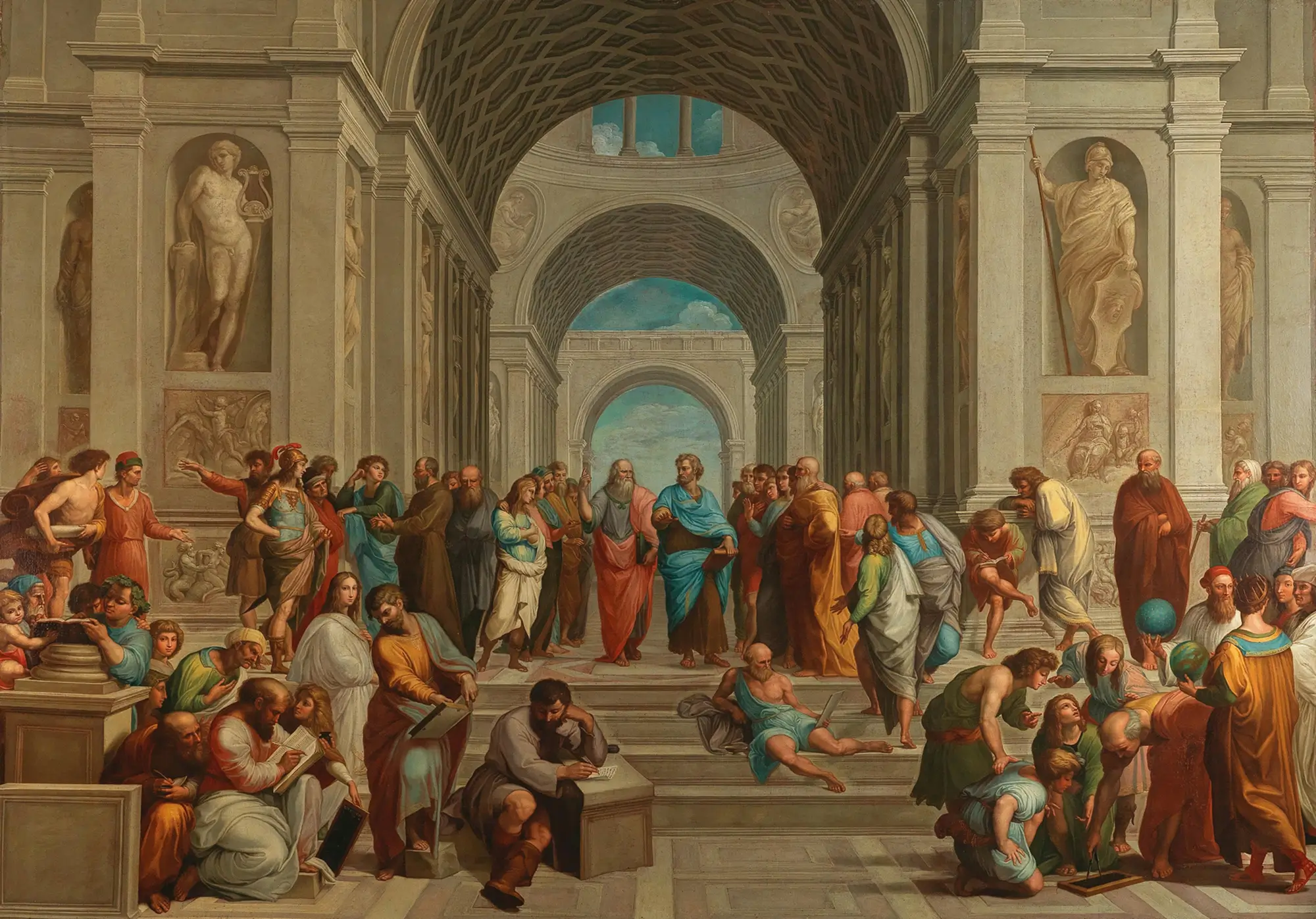
John Paul II brought to the papacy all the knowledge and experience that Karol Wojtyla had developed up to that point in his life. He was a lover of beauty—a poet. He was also a lover of wisdom—a philosopher. Philosophers ancient, medieval, and modern have often concerned themselves with beauty as much as with thought experiments. Some thinkers have attempted a definition of beauty itself, and many more have simply used the eloquence of poetry as the vehicle of their observations and propositions.
The ancient philosopher Parmenides of Elea, who set off into the murky waters of metaphysics and whose thinking influenced others like Aristotle, composed a poem which addressed the competing realities of the universe’s actuality and the subjectivity of mere mortals’ perceptions of that same universe. Fast forward to medieval times and we find the Dominican and famed scholastic St. Thomas Aquinas not only delivering explanations of God’s created order but also writing hymns praising the glory of God in the Eucharist, including the Adoro Te Devote and Pange Lingua. And later, in the wake of the Enlightenment era, Ralph Waldo Emerson developed American Transcendentalism, which served as a conceptual marriage between a Romantic view of nature and a loose sense of a permeating but nameless divinity, which was also associated with the human spirit. Emerson, too, produced poems as well as essays, a craftthat nature lovers are wont to apply themselves at.
Just like the great poet-philosophers before him, John Paul II was adept at communicating his thoughts in both rigorous prose and sublime poetry. If we examine his encyclicals and papal letters as well as some of his earlier poetry, we can notice the recurrent themes of his “heartsong,” as Mattie Stepanek might put it. We can glimpse those things that he held near and dear to his heart.
The Marriage of Faith and Reason
In his 1998 encyclical Fides et Ratio, John Paul II wrote a now famous statement in the document’s opening lines: “Faith and reason are like two wings on which the human spirit rises to the contemplation of truth.” If we abandon either of these—giving in to fideism and superstition or capitulating to rationalism, empiricism, or scientism—we navigate reality in a lopsided way, closing ourselves off to the fullness of the created order, and are destined to fall.
A decade earlier, in a letter to the director of the Vatican Observatory, Pope John Paul II stated, “Science can purify religion from error and superstition; religion can purify science from idolatry and false absolutes. Each can draw the other into a wider world, a world in which both can flourish.” The Christian worldview then, in its search for truth, must proceed with the complimentary lights provided by faith and reason, religion and science.
John Paul II’s poetry is dripping with spiritual realities, those we hold through faith. But he also speaks of the right role of our rationality. In the poem “Now I begin to discern individual profiles,” under a sub-section devoted to “Man of Intellect,” he writes, “...each road must take the direction of thought.” In other words, we never abandon the gift of our intellect which God instills in us. We must use reason in forming our opinions and in deciding what course of action to take.
The Dignity of Human Work
As a young man, Karol was no stranger to hard physical labor. His jobs included working at a stone quarry and a chemical plant. He wrote a substantial poem reflecting on the former, simply titled “The Quarry.” In one passage, he writes:
Listen: the even knocking of hammers,
so much their own,
I project onto the people
to test the strength of each blow.
Listen now: electric current
cuts through a river of rock.
And a thought grows in me day after day:
the greatness of work is inside man.Hands are the heart’s landscape. They split sometimes
like ravines into which an undefined force rolls.
The very same hands which man only opens
when his palms have had their fill of toil.
Now he sees: because of him alone others can walk in peace.
Throughout Scripture, God reminds us of the significance of the work of our hands. Not only is it a means of providing for ourselves and others; it also serves as the way in which we contribute to the wider community and by which we shape the world for the better.
Already in his youth, laboring in the quarry, Karol recognized the dignity of work, regardless of what the specific tasks might look like: “The greatness of work is inside man.” Decades later, he dedicated an entire encyclical to this theme, Laborem Exercens. There he writes:
...human work has an ethical value of its own, which clearly and directly remain linked to the fact that the one who carries it out is a person, a conscious and free subject, that is to say a subject that decides about himself....the basis for determining the value of human work is not primarily the kind of work being done but the fact that the one who is doing it is a person. (LE 6)
In an age brimming with anxiety over AI’s workplace applicability, it is good to remind ourselves that the value of work that Christ and his Church are concerned with is the human component, the worker, the individual person made in the image and likeness of the Creator. Ultimately the dignity of human work is an extension of the innate dignity of the human person.
The Inherent Dignity of Human Life
The Catholic Church has long championed the dignity of human life from conception to natural death. Harkening back to the 5th commandment of the Decalogue (cf. Ex 20:13), numerous encyclicals, such as Pope St. Paul VI’s Humane Vitae and John Paul II’s Laborem Exercens, have been written defending the sanctity of life and the rights inherent to the human person. As Catholics we understand there are other sins besides physical killing that break the 5th commandment. These include bringing harm, shame, or ill repute upon a fellow child of God.
The modern milieu of egotism and the quest for dominance over others sows the seeds of what John Paul II called the “culture of death.” It leads to a view marked by the supposed cheapness of life. We begin to treat other people as objects and as means to our goals, instead of worthy ends in and of themselves. Countering the culture of death is the culture of life, which is the subject of John Paul II’s encyclical Evangelium Vitae. It opens with a simple notion: “The Gospel of life is at the heart of Jesus' message. Lovingly received day after day by the Church, it is to be preached with dauntless fidelity as ‘good news’ to the people of every age and culture.” Our Lord himself professes, “I came that they may have life, and have it abundantly” (Jn 10:10b).
As God’s creatures, we are endowed with beauty. As creatures made in God’s image and likeness, we are ennobled with dignity—the dignity of personhood—and called to the pursuit of holiness. John Paul II not only recognized this but, having witnessed the damage done by the culture of death, acted in defense of the sanctity of human life. We see traces of this sentiment in his poetry as well. In “Hope reaching beyond the limit,” he writes about the worthiness of all life, saying:
In that space—the world’s fullest dimension
You are
and therefore both I
and my slow fall to the grave
have meaning:
my passage unto death;
the decay turning me to dust of unrepeatable atoms
is a particle of Your Pasch.
These brief lines convey important truths about the human condition. Wojtyla weighs Christ’s “Pasch” with his words, referringto his Lord’s Passion and victory over death. In his own literary way, he reiterates to his mortal readers that, by living and suffering well, we join ourselves to Christ. Thus, Jesus elevates even the ugly parts of life.
The Holy Eucharist: Source and Summit of Our Faith
The endurance of great suffering without devolving into bitterness requires a strong faith. Catholics believe that we not only have the written Word of God but also have the fullness of Jesus Christ’s presence in the Eucharist. The Church refers to this awe-inspiring Sacrament as the “source and summit,” or the “fount and apex,” of the Christian life (cf. Lumen Gentium 11). Why? Because it is Jesus himself. He is the source of our faith and the goal toward whom we wish to orient our lives.
Over the centuries, there have been many beautiful theological and philosophical treatments of the Blessed Sacrament. As noted earlier, St. Thomas Aquinas wrote eloquent hymns to the Eucharistic Lord. There is little wonder then as to why Karol Wojtyla also wrote poetry about the Holy Eucharist. Quite simply, he loved Jesus. In a section of his poem “Shores of silence,” the young saint writes:
I bring you good news of great wonder, Hellenic masters:
it is pointless to watch over existence
which slips out of our hands,
for there is a Beauty more real
concealed in the living blood...
A morsel of bread is more real
than the universe,
more full of existence, more full of the Word—
a song overflowing, the sea,
a mist confusing the sundial—
God in exile.
The pagan philosophers of Greek antiquity—Parmenides, Aristotle, and their contemporaries—did not receive the same enlightenment about the coming of Christ as the Israelites did. A young Wojtyla proclaims the Gospel to them, focusing on the fullness of Beauty (God himself)perceived as a “morsel of bread.” The poetry illustrates how God humbles himself not only in the Incarnation but even further through transubstantiation into a small, unassuming, and compact appearance.
For Pope John Paul II, the pinnacle of the Gospel is the Eucharist. He elaborates on the nature of this Sacrament in his encyclical Ecclesia de Eucharistia:
The Eucharist, like the Canticle of Mary, is first and foremost praise and thanksgiving. When Mary exclaims: “My soul magnifies the Lord and my spirit rejoices in God my Saviour,” she already bears Jesus in her womb. She praises God “through” Jesus, but she also praises him “in” Jesus and “with” Jesus. This is itself the true “Eucharistic attitude.” (EE 58)
This emphasis on eucharistia as “thanksgiving” points us to a crucial fact: We would not have Jesus the Man,and thus neither would we have Jesus as our Eucharistic Lord, without the Blessed Virgin Mary, the Mother of God. The motherhood of Mary figures prominently in several of Wojtyla’s poems. As Pope, he pondered her role at length in another of his encyclicals titled Redemptoris Mater—“Mother of the Redeemer.”
Since Mary was conceived without stain of Original Sin and because she never failed to be faithful to God, she is Stella Maris, “Star of the Sea,” a guiding light serving as our exemplar in prayer and action. In the encyclical, John Paul II states that Mary’s life is the pattern on which the Church models herself in her devotion to Christ. We put ourselves at the disposal of Jesus.
We can also learn from the Blessed Mother through her prayer, particularly the “Canticle of Mary,” also known as the “Magnificat.” The Magnificat was not only Mary’s heartsong but, as John Paul II says, through the Liturgy of the Hours, it “ceaselessly re-echoes in the heart of the Church down the centuries” (RM 35). It is to be our heartsong as well—and that of the whole people of God.
The Magnificat is Mary’s profession of faith; it is also an outpouring of gratitude. The prayer further imparts to its listeners the Church’s preferential love for the poor as gleaned from verses such as the following:
He has cast down the mighty from their thrones, and has lifted up the lowly.
He has filled the hungry with good things, and the rich he has sent away empty. (Lk 1:52–53)
Once again, we see in the Gospel of life the defense of the human person, especially the most vulnerable of individuals. Perhaps it takes the heart of a poet—like the Virgin Mary, like Thomas Aquinas, like Pope John Paul II—to more readily recognize the beauty of life and the gift that it is from God. By the words and deeds of the saints, we too can cultivate a heart attuned to the beauty of life and respond accordingly.
To learn more about Pope St. John Paul II's appreciation of human creativity, read his Letter to Artists here.
To hear more about what Pope St. John Paul II preached about the vocation and duties associated with the priesthood, explore our upcoming re-release of Letters to My Brother Priests here.

John Tuttle
John Tuttle is an editorial assistant at Midwest Theological Forum. He has worked as a diocesan communicator, teacher, and reporter. His writing has been published by Catholic World Report, The Wanderer, The Observer, Boone County Journal, Starting Points Journal, University Bookman, Jesuit Media Lab, VoegelinView, and other outlets. He and his family live in northern Illinois.

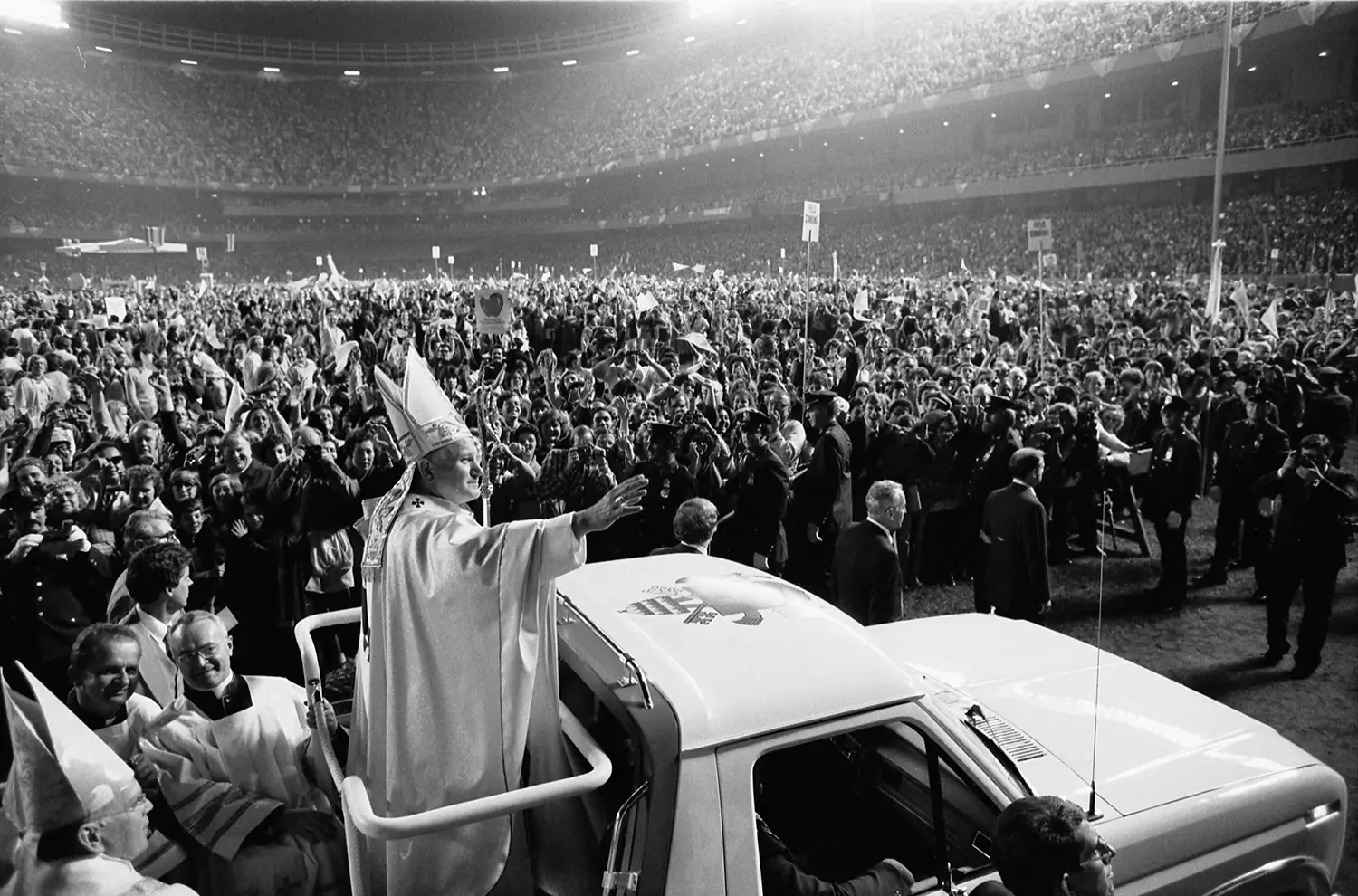
Pope John Paul II at old Yankee Stadium, New York City, in October 1979.