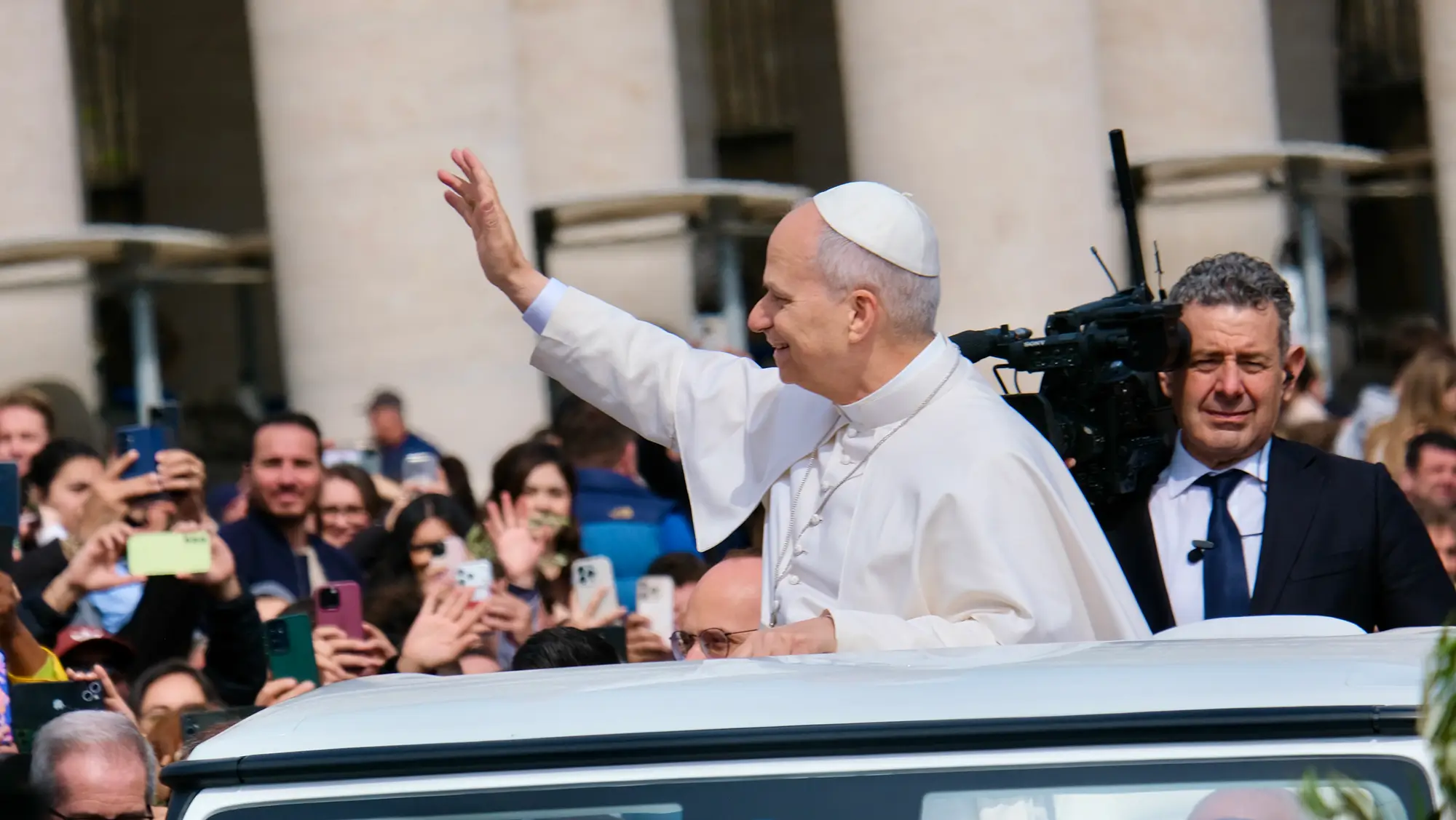
Pope Leo XIV’s inaugural encyclical Magnifica Humanitas, or “Magnificent Humanity,” addresses current issues that impact many people as well as important truths about the human condition, including the inherent dignity common to us all.
When words are simulated, they do not build genuine relationships, but only their appearance.
– Pope Leo XIV in Magnifica Humanitas
It was published on May 25, the memorial of the Blessed Virgin Mary, Mother of the Church. Since the start of his papacy, the word on the street has been that Leo would compose an encyclical directly addressing AI. The timing is appropriate, and the message is certainly needed. As Catholic University of America professor Charles Camosy succinctly stated, “The Church is not releasing a social document because things are going well.”
Leo XIV took his papal name in honor of Pope Leo XIII (1810-1903), a pope well-known for championing human rights amid the turmoil of the Second Industrial Revolution and its implications for workers. His landmark encyclical, Rerum Novarum, laid the foundation for Catholic social teaching. Our current pontiff signed his encyclical on May 15, ten days prior to its public appearance, an homage to Rerum Novarum, which had been signed on that same date in 1891.
In Magnifica Humanitas, Pope Leo XIV borrows Leo XIII’s phrase “new things,” referring to developments in the modern world, the impetus for writing such a document as this encyclical. Among these “new things” that have the potential to destabilize many dimensions of human existence is artificial intelligence (AI). His words could not come at a better time.
Let us explore some highlights from Magnifica Humanitas.
Human Dignity, the Foundation for Building
- “We must lovingly safeguard the grandeur of humanity bestowed upon us and revealed in its fullness in Christ, the splendor of which no machine can ever replace.”
- Instead of being architects of a new Tower of Babel, an image conveying fallen humanity’s tendency to seek its own glory apart from God, we should strive to be “builders of communion” with one another.
- We should be like Nehemiah and the remnant of Israel who returned to the decimated City of Jerusalem and there rebuilt relationships (with one another and with God) as well as their city.
A Fully Human Approach to AI
- People, including those who engineer various versions of AI, possess only a limited understanding of their actual functioning.
- This reality demands our renewing “a twofold commitment: on the one hand, a deepening of scientific research; on the other, the exercise of moral and spiritual discernment.”
- AI is a valuable tool that warrants user discretion.
- Important and sensitive decisions deserve to be authentic human decisions instead of actions delegated to an impersonal automaton.
- “For AI to respect human dignity and truly serve the common good, responsibility must be clearly defined at every stage: from those who design and develop these systems to those who use them and rely on them for concrete decisions.”
Risks to Consider When Using AI
- Among the risks that AI runs are its potential to “weaken personal creativity and judgment” in its users and to “place heavy demands on natural resources” via its operating systems.
- AI can be used by those with malicious intent, but “a subtler danger” exists within the realm of misinformation/disinformation. This is because “when AI systems present themselves as neutral and objective, they end up reflecting and reinforcing the stereotypes or ideological bias of their designers and developers.”
- Because of such bias, “we cannot consider AI to be morally neutral.”
How Not to Use AI
- AI should not be used to amplify those in power, nor should it undermine social justice and solidarity. Instead, it should be used equitably.
- AI-powered weapons, autonomous by their nature, are less subject to human control.
- “This violates the principle that armed force should be used only as a last resort in cases of legitimate self-defense. For this reason, the development and use of AI in warfare must be subject to the most rigorous ethical constraints, to guarantee respect for human dignity and the sanctity of life and to avoid a race to develop such arms.”
How to Build a Civilization of Love
- We should strive to build up a civilization of love in which we protect human life and the common good.
- “In order to build the civilization of love, we must engage in dialogue, for this is the primary means of coexistence between people and nations, and it is the alternative to open conflict.”
- “The spirituality that we need is a Eucharistic spirituality, that is, a spirituality of ecclesial unity in love.” When we receive Jesus in the Holy Eucharist, we call it communion. In this, we are untied to Jesus and mystically to all the faithful: we become “one body” in Christ.
The Holy Father offers us a lot to ruminate and act upon. AI has been widely discussed, feared, lauded, and implemented in both Catholic and secular circles. Even before the encyclical was released, Sr. Nancy Usselmann, the Director of Pauline Media Studies, recognized that the Church ought to use all new and developing technologies, including AI. Matthew Harvey Sanders developed Magisterium AI, a generative AI reminiscent of ChatGPT, which brands itself as the “world’s #1 answer engine for the Catholic Church.” Truthly.ai is another helpful AI app that has gained favorability among the faithful and has gained traction particularly in the Diocese of Charlotte.
In most professional spheres, AI is the subject of staff meetings. It dictates marketing strategies. It generates answers to the never-ending flow of human questions. And it is cast in sci-fi thrillers, often appearing as a malevolent machine bent on destroying human life.
In reality, AI is a tool, not a person. It is not intent on our destruction. But our own lack of intention and discretion in our use of this advancing technology could take us down a dark path.
While AI can impact the workforce, the economy, and how we spend our time, such technology cannot replace the human being. It is never a true equivalent to a person. As Jose Angel Lombo and Francesco Russo write in their Aristotelian-Thomistic discourse Philosophical Anthropology:
This fact marks a radical difference between artificial intelligence and human intelligence because the latter is never just the mere execution of operations comparable to those of a computer. As we have said, the human being exercises his cognitive faculty in association with the senses and with his affective, or emotional, states as well as interacting with the surrounding environment.
AI systems are given inputs and exposed to vast corpora of data previously discovered or developed by humans. Meanwhile, human persons have sense experiences. They see, touch, and smell the world outside of themselves, and they have free will in deciding what they will do.
In this moment, too, we choose what we will do next! The pontiff reminds us that we need to cultivate judgment and responsibility in ourselves instead of delegating all our decisions to a machine. So how do we live a truly fully human existence? In Magnifica Humanitas, Pope Leo XIV paints a beautiful picture of what it has looked like in the past and what it could look like in the future:
The quality of a civilization is measured not by the power of its means, but by the care it is able to offer, by its ability to recognize the other as a face not merely as a function. The ability to care for one another is a fundamental dimension of our humanity, one that is learned and mastered through lived experience. Reading stories to a child, offering company to an elderly person and arranging a home so that it is welcoming are simple gestures often rooted in family life. They teach us to value care at a societal level and train us to recognize others as persons worthy of attention.
Our Lord sums up the standard of such a civilization perfectly when he tells us, “A new commandment I give to you, that you love one another; even as I have loved you, that you also love one another” (Jn 13:34).

Photo: Pope Leo XIV from Prelatura de la Santa Cruz y Opus Dei