The Evangelical Power of Narrative
Whether or not Pope Leo XIV possessed a storyteller’s gift before his election, his first apostolic exhortation shows that he understands how narrative enchants the soul of the modern person. Dilexi Te, or “I Have Loved You,” (hereafter referred to as DT) reveals his conviction that recapturing the soul for Christ comes through a narrative that gives flesh to theology and heart to doctrine. In DT, Leo uses a story to lead readers into the Church’s teaching on her preferential love for the poor, weaving the document itself into a narrative arc. In both content and structure, DT becomes a story about divine love that makes poverty its teacher and humanity its subject.
In the first chapter of DT, Pope Leo quotes notable accounts of Jesus’ teaching on the poor. The first is his encounter with the woman accused of extravagance for pouring out expensive perfume in anointing the Lord (Mt 26:8-11). A superficial reading of this story appears contradictory to the focus of DT. As the Apostles ask, “Why this waste? For this ointment might have been sold for a large sum, and given to the poor” (Mt 26:8-9), one could, and many disingenuously have, asked this very question of the Church. These questions often arise in response to the Church’s focus on the seemingly frivolous things of beauty and liturgy, realities that the world deems impractical.
However, like the paradoxes of the Catholic faith itself, the penitent woman appearing to waste her expensive perfume by anointing the head of Jesus highlights a primary theme of DT—there are deeper poverties than merely financial poverty (DT 4). Any work the Church does to serve the material needs of the poor must proceed from its love, devotion, and sacrifice for Christ.
“I Was Hungry”
Another prime example that Leo draws from the Gospels is Christ identifying with those without money for food, drink, or clothing in the parable of the sheep and the goats found in Matthew 25 (DT 5). While natural charity can serve philanthropically, only the theological virtue of faith can see Christ truly present in the poor themselves. To merely give alms still sees the poor as “other.” Only in seeing Christ in them can one see their evangelical power as a means of grace.
Paragraph 18 finds DT’s first reference to God’s identification with the poor through his act of kenosis, or “self-emptying.” This condescension on the part of the Second Person of the Blessed Trinity entailed taking on our human nature along with its limitations, while at the same time maintaining his divinity. Jesus also took on the poverty particular to the family he was born into. Thus, God can identify with material poverty because, in the person of Jesus, he took on both metaphysical and material poverty. This process did not happen spontaneously but was the result of a progressive action of God throughout history, which started at the beginning of his revelation to Israel.
In reflecting on the many Old Testament passages showing God’s acknowledgement of and special care for the poor, Pope Leo begins a narrative within the document that carries the reader across biblical history to show the ancient roots of this essential Christian doctrine. Along the way, readers witness the intensification of this narrative as God’s revelation progresses. Paragraphs 24-34 provide thoughtful reflections on biblical passages relevant to the poor. The three big themes in these passages correlate care for the poor with authentic love of God (DT 24-26), care for the poor as true worship (DT 27-28), and care for the poor as faith in action (DT 29-30). The Pope then cites examples from the early Church of this crucial care for the poor.
Uniting Belief and Social Action
After reflecting on these biblical passages, the next portion of DT offers a brief historical survey of early Church Fathers and their writings on the poor. Many of these quotes reinforce what has already been said in the preceding lines. Like the perspectives the Fathers provide on most issues, their wisdom offers a clear continuity for Christians seeking to understand and live in accord with orthodoxy, or “right belief,” and orthopraxy, “right practice.” DT then takes its reader through an historical survey of the Church’s long tradition of teaching and practice concerning care for the poor.
The reader hears from St. Ignatius of Antioch, who considers that neglect of the poor stands in opposition to the will of God. St. Justin Martyr, who boasts the oldest, post-biblical description of the Mass, ties the work of the liturgy to the Church’s work with the poor. Finally, St. Polycarp emphasizes the unique role of “ministers” (the clergy) in service of the poor. What unites these three examples from DT is that they all speak to the value of the Church’s witness in relationship to the poor. Fittingly, these references all come from famous martyrs, that is witnesses, of the early Church.
A Church Which Is Poor and for the Poor
One detour worth taking here is to highlight a line Pope Leo provides that could easily be overlooked. It is, however, worth pausing and reflecting on. He cites an early quote from Pope Francis desiring a Church that is both “poor and for the poor.” (DT 35). The desire for the former likely convicts us more than the latter, but the reality of the former essentially precedes the latter.
In order for the Church to truly be for the poor, she herself must be poor. One recent example of this “becoming poor” is found in an American whose cause for canonization is recently advancing: Servant of God Dorothy Day, known for co-founding the Catholic Worker Movement and its associated Hospitality Houses, which still operate today. These houses serve impoverished communities and function as local food pantries. However, they are also much more. The tenants of these houses will not only distribute food to neighbors in need but will sometimes host meals. On these occasions, instead of an assembly line like the traditional “soup kitchen,” the tenant, any volunteers, and those neighbors in need all work together to prepare and serve the meal as well as help bus tables and clean dishes afterward. In this way, the Church has shown its commitment to the poor precisely by communing with them.
This flows from Christ’s identification with the poor as well as the Church’s identification with Christ, since she is his Bride (cf. Jn 3:29; Eph 5:25; Rev 19:7-9) and Body (cf. Col. 1:18). Like Jesus, the Church becomes “poor” to be fully compassionate toward the impoverished. It is the Church’s ability to similarly identify with the poor that unites her more closely to Christ. This is shown primarily in her countless saints. The saints, especially the ones who were unknown to the world and who will likely never be canonized, illustrate the Church’s poverty. Most Christians throughout history were humble, simple, and poor, living quiet lives of love and devotion to God and others. But without these men and women the Church could not stand today as the historic yet eternal, imminent yet transcendent, humble yet powerful, extension of Christ in the world.
Because They Are Witnesses
Continuing through Church history, something striking from the text of DT were the examples of saint stories that illustrate Pope Leo’s points about caring for the less fortunate. Many Vatican documents are replete with quotations from saints, including DT, but I do not remember any with as many stories of the saints. One finds the famous deacon St. Lawrence presenting the destitute to the emperor as the treasures of the Church (DT 38). There are St. John of God and St. Camillus de Lellis founding religious orders dedicated to healing the impoverished, and the Daughters of Charity of St. Vincent de Paul who run similar apostolates (DT 50-51). Readers encounter St. Basil and St. Benedict, who wrote in their respective rules to minister to the poor (DT 53, 55). We also encounter St. John of Matha, St. Felix of Valois, St. Peter Nolasco, and St. Raymond of Peñafort, who all worked to redeem and free slaves and prisoners (DT 60).
Then there are Sts. Francis and Clare of Assisi as well as St. Dominic, who are upheld as special models of those who sought to identify with poverty in a similar manner as Christ (DT 64-66). No list of exemplars for service would be sufficient without a mention of St. Teresa of Calcutta (Mother Teresa), who specifically sought out the “poorest of the poor” (DT 77). These are not even half of the examples that Pope Leo utilizes in this document to emphasize the various impactful ways that the saints have lived out Christ's call to feed the hungry, clothe the naked, and help those in need.
It is as though Pope Leo is trying to emphasize the great truth proclaimed by Pope St. Paul VI that “modern man listens more willingly to witnesses than to teachers, and if he listens to teachers, it is because they are witnesses” (Evangelii Nuntiandi 41). The teaching that the Church must bear witness to is the beauty and sanctity of poverty.
There is a temptation to see all the Pope’s examples through a utilitarian, and therefore suspicious, lens. Has the Church lifted more out of poverty than modern economic expansion? Has the Church healed more than those harnessing advanced medical technologies? How many captives has the Church freed compared to modern prison reforms? Has the Church taught more to read than the exponentially higher number of youth enrolled in public education? As great as these results may be (and praise God for the Holy Spirit inspiring these movements), that is not the game the Church is playing. The Church is not solely, not even primarily, interested in numbers. The Church is interested in love, because without love she would just be “a noisy gong or a clanging cymbal” (1 Cor 13:1).
The Power to Change Reality
The document’s focus pivots as it draws to a close. Up to this point, Pope Leo’s examples were exclusively saints who happened to be professed religious or members of the clergy. Now, he acknowledges the contribution of the laity in developing the “acceleration of technological and social change in the past two centuries” (DT 82).
One of the document’s most powerful lines comes in paragraph 91 when Leo states, “Charity has the power to change reality.” This is hardly pious sentimentalism but is necessarily true according to our faith. In light of profound statements like “God is love” (1 Jn 4:8), the Catholic tradition has understood that charity, like all God's attributes, is identifiable with his own essence. St. Thomas Aquinas also refers to God as ipsum esse or "existence itself” (ST I. Q 4. A 2. resp.). Therefore, charity not only changes reality; it is its fundamental structure. This means that acts of true charity go much deeper than merely being heartfelt gestures; they are metaphysical. If God is sacrificial love and also existence itself as noted above, then a person’s charitable action is a participation in the very foundation of reality, a participation in God’s essence. We have been made for love by Love himself, and he beckons us to respond with love. Only according to this Christian view can we say that even little things done with great love make a difference.
The significance of love is deepened by its relationship to the Incarnation of Christ. In paragraph 103, Pope Leo uses incarnational language to describe the Christological identification with the poor that the entire document has been promoting. He says that “the Church experiences the lives of the poor as her very ‘flesh.’” He would reiterate this incarnational language a few paragraphs later by saying that the poor cannot be seen as “a sociological category, but the very ‘flesh’ of Christ” (DT 110).
Fittingly, in between these two citations, one finds a brief reflection on the parable of the Good Samaritan, a story that incarnates the multi-dimensional reality of Christian love for the poor. This addresses several elements the Pope previously mentioned while doing so in the form of one of Christianity’s most familiar narratives. The robbed and injured man is materially, physically, and relationally impoverished, highlighting the various types of poverty that Christians are called to address. By using a Samaritan as the hero of the story, Jesus seeks to instruct his listeners, freeing them from a prison of ignorance and prejudice. By including the priest as a passerby, Jesus also anticipates and objects to the worship-versus-serve-the-poor dichotomy to which many are tempted, such as those who were angered by the woman who poured costly ointment over Christ’s head. Like Jesus’ parables, DT invites us to see Christ in the poor and, like the Lord, to become poor and vulnerable in the act of caring for them.
Christ Became Poor So that We Might Become Rich
Dilexi Te reminds the Christian people of several important truths pertaining to our faith. These include the following:
- Christ became poor to identify with the poor.
- Care for the poor is authentic love of God.
- Care for the poor is true worship.
- Care for the poor is faith in action.
- The Bible illustrates the Church’s preferential love of the poor.
- History illustrates the Church’s preferential love of the poor.
- Charity reflects, and changes, reality itself.
This apostolic exhortation also carries a strong sense of narrative in its content and construction. Stories abound throughout the Pope’s writing, and the structure of the document itself gives readers, by the end, a sense of having come full circle. Pope Leo bookends DT with the same verse with which he began, but now we have a fuller appreciation of the implications of this verse for our own lives. Readers hear the words of Jesus in Revelation 3:9 saying, “I have loved you,” and recognize the responsibility to extend that love to those around them. According to Pope Leo XIV, the words are directed to the readers, so that they can be received and then redirected to the poor.
Incidentally (although one doubts accidentally), the verse itself comes from the same book of Scripture where Jesus calls himself “the Alpha and the Omega” (Rev 1:8), the beginning and the end. There is something to this bookending when it comes to understanding Christian poverty. The exaltation of poverty began with God in his self-emptying at the Incarnation (cf. Phil 2:5-11). God will also be found in the poor at the end of humanity’s redemption (as presented in Mt 25:31-46) because he will identify with the poor as the hungry, the thirsty, the naked, and the imprisoned. Pope Leo, in Dilexi Te, helps us recognize our Lord Jesus in this way.

Mike Schramm
Mike Schramm holds an MA in theology and an MA in philosophy. He lives with his wife and seven children in southeastern Minnesota where he teaches theology and philosophy at Aquinas High School and Viterbo University. You can find his writing at Intellectual Takeout, Busted Halo, and the Voyage Comics Blog. He is also the managing editor of the Voyage Compass, an imprint of Voyage Comics and Publishing.

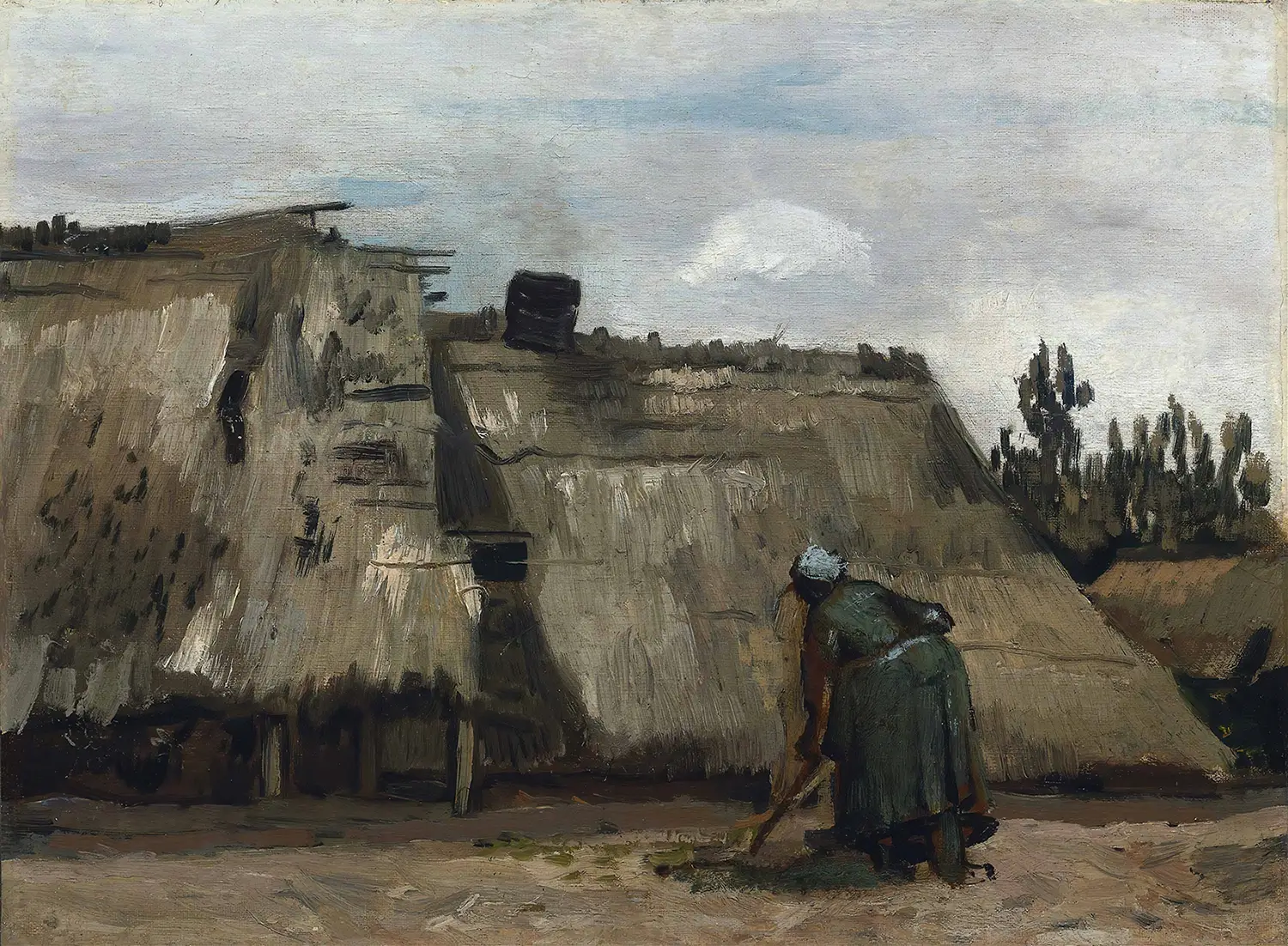
A Peasant Woman Digging in Front of Her Cottage by Vincent van Gogh.