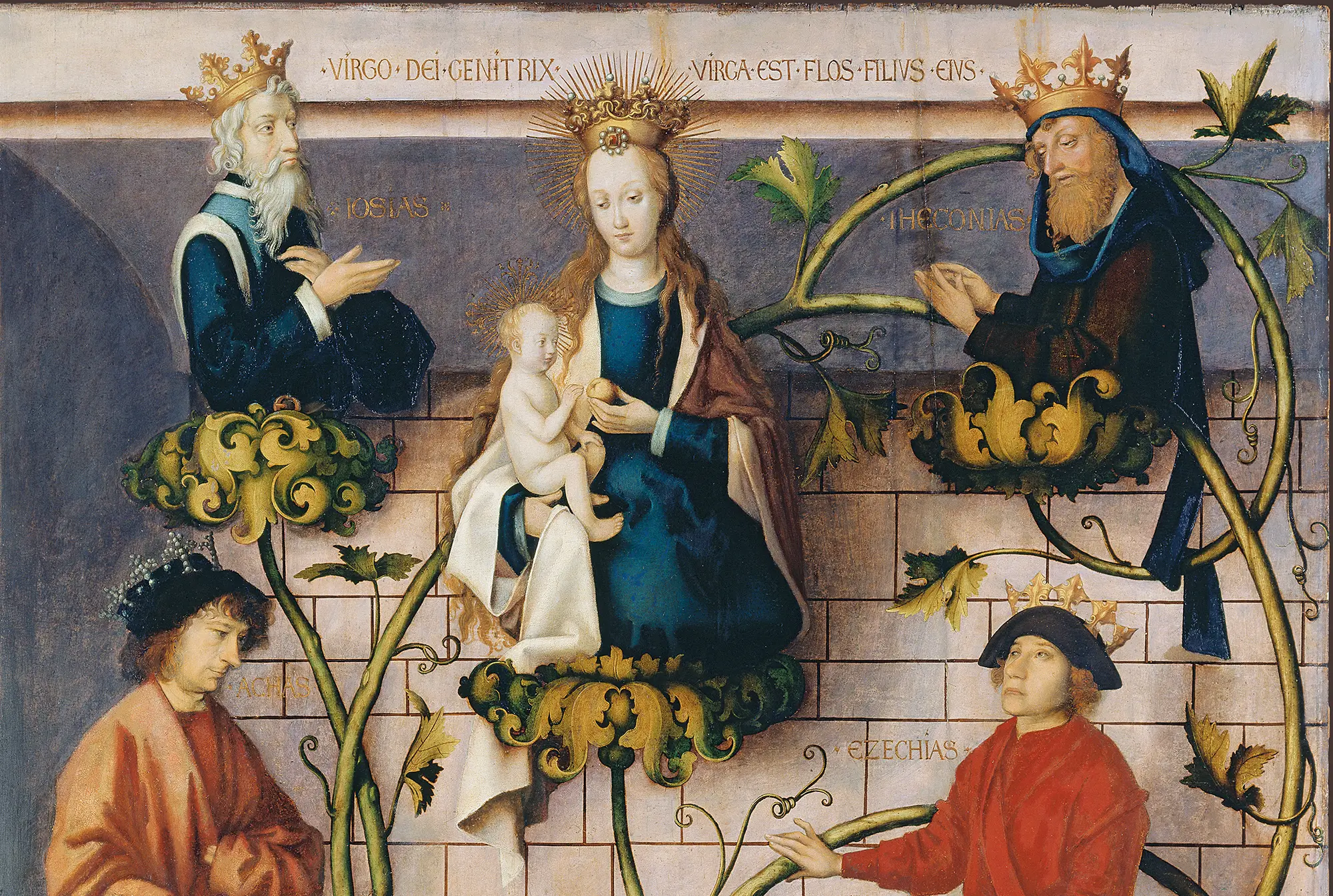
This week we celebrate the Feast of the Nativity of the Blessed Virgin Mary on September 8. Though a major celebration in the life of the Church, the longer form of the gospel for the day is far from popular. It is largely the genealogy of Christ as recorded by the Apostle Matthew (cf. Mt 1:1-16, 18-23). When we encounter these sorts of passages in Scripture, we often ask ourselves what their purpose is. Why did Matthew, under the inspiration of the Holy Spirit, deem this long list of names important enough to begin his gospel? Why did the Church deem this list important enough to be read at a major feast? On one level this genealogy is important because it shows that Jesus Christ is the heir of King David and thus the rightful King of Israel. And one could say that, as the most proximate ancestor of Christ, the celebration of Mary’s birth is an appropriate occasion to recall this genealogy.
But it does much more than that. It is a snapshot of how God worked throughout the history of Israel and tells us how he continues to work in our lives today. This work can be broadly categorized as follows: The Obvious, The Surprising, and The Invisible.
The Obvious
“The Obvious” describes those ancestors through whom God's work is most easily seen. These are people like Abraham, who left his family and homeland to follow the Lord into the unknown (cf. Gn 12:1-7), or David, who sought to follow God faithfully and praised him in song (cf. 1 Sm 13:14; 2 Sm 22:1).
We can also reflect on our personal history and find moments where God has worked in clear and concrete ways. Our Baptism and Confirmation, the worthy reception of the Eucharist at Mass, and personal consolations in prayer are examples of these moments, and there are surely many more. From these ancestors and moments of encounter we can draw an assurance of God's goodness and his continual work in our lives.
The Surprising
“The Surprising” describes those ancestors through whom it is unexpected and even scandalous to hear that God worked. These are people like Ahaz, a king descended from David who sacrificed his own children to pagan gods (cf. 2 Kgs 16:1-3), or Manasseh, Ahaz's grandson, who built altars to other gods in the Lord's Temple (cf. 2 Kgs 21:1-6).
Despite these horrors God still brought Christ to the world through these men. This does not mean that their actions were permissible because “it all worked out in the end.” The wonder of God's work is precisely that these men did horrible deeds, but that God was not thwarted and remained faithful to his promise. We can also see this in our own lives, such as when we fall into sin and are granted the gift of repentance and conversion by the Holy Spirit.
Maybe there have been moments when we were able to use a story of our sins and failings, and how we overcame them by the grace of God, to help encourage a friend in their faith. Perhaps, after someone has confided in us one of their own difficulties, we have shared how we struggle just the same and have not given up the fight. From these ancestors and these moments of stumbling we can deepen our trust that nothing “will be able to separate us from the love of God in Christ Jesus our Lord” (Rom 8:39).
The Invisible
Perhaps the most important lesson from this gospel comes in “The Invisible.” These are those ancestors through whom God worked, but in ways that are entirely unknown to us. After Zerubbabel the next nine generations of ancestors are mentioned nowhere else in Scripture. The royal line of David, through which God had promised to bless the world (cf. 2 Sm 7:12-16), seemed to vanish from history. Despite this obscurity God did not forget or abandon his promises. These men and their families continued to live smaller, more mundane lives until Joseph, a righteous man and the son of Jacob, was betrothed to Mary.
We can see glimpses of this in our own lives when we realize, often with a great deal of hindsight, that God has been present with us in our smallest moments. Perhaps we can recall seemingly unimportant decisions or “coincidences” that we now know were moments of grace, either for us or for someone else, that God worked through us. These moments are necessarily the hardest to see, but we can rest assured that an abundance of such moments will be revealed to us in heaven.
As St. Josemaria wrote, “Anything done out of love is important, however small it might appear.... Nothing is wasted. No man is worthless to God” (Christ Is Passing By, no. 44).

Sam Landon
Sam Landon is an Associate Editor at Midwest Theological Forum. He holds a master’s in religious studies specializing in New Testament and early Christianity from the University of Chicago. He has worked extensively in campus ministry to help young adults grow closer to Christ. He and his wife live in Chicago, IL.
Artwork: The Tree of Jesse by Hans Holbein the Elder