Without God revealing himself to us in particular ways and in specific moments (for example, through his communication with the prophets and, especially, via the Incarnation), our knowledge of him would be severely lacking. We would not otherwise know God in a personal manner. We would not know his Name. We would not know many of his key attributes, such as his love and respect for his creation.
Even in the fullness of faith, there is an aloofness about God. Being pure spirit he is invisible to the eyes of the flesh. We read in Scripture, "No man has ever seen God. . ." (1 Jn 4:12). At every moment he maintains our existence. Even a naturalistic philosophy could come to some understanding of the omnipresence of an all-powerful God. So, though he may be imperceptible to our senses, God is nonetheless present to us and all creatures always.
Our Catholic faith offers us a familiar term with which to describe this all-encompassing presence of God, and that word is grace. Grace is God's living and effective gift that works toward our sanctification and salvation. In a sacramental worldview, everything is imbued with grace. But the Catechism of the Catholic Church also states that since "it belongs to the supernatural order, grace escapes our experience and cannot be known except by faith" (CCC 2005). While by faith we believe God's grace to be everywhere, we see it nowhere.
The Transcendent God
Thus we are met with the paradox of God's intimate closeness to creation and his distance from our total apprehension or comprehension. That God is above and beyond our complete understanding can also be referred to as his transcendence. The New Catholic Encyclopedia (Catholic University of America, 1967) describes transcendence in this way:
From the Latin transcendere, meaning to climb over, to surpass, or to go beyond, [it is] a term describing the relation existing between two things when one is superior and extrinsic to the other.
God is certainly superior to us, and to everything he has brought into being, just as a human artist is superior to his artwork. He transcends all creation cosmologically, ontologically, and epistemologically. We are the Creator's handiwork. And as human persons we have the privilege of being counted among God's masterpieces. We have been made in the imago Dei and thus bear a certain resemblance to our heavenly Father. But the work of conversion calls us out of ourselves, beckoning us to become more like God. This is the goal of self-transcendence.
The Common Search for Self-Transcendence
The Catholic scholars, Rev. Jose Angel Lombo and Rev. Francesco Russo, in their book Philosophical Anthropology, write about the upward momentum of self-transcendence intrinsic to human nature. Lombo and Russo suggest that the individual's persistent quest for self-fulfillment is a sign "of his constant self-transcendence, that is, of his projection beyond the particular situation and beyond himself." There has to be something more that will satisfy the unmet needs of human personality that spur us on to keep looking for a solution. Continuing in this vein, the writers explain:
This is a fundamental characteristic of the human person, one that can be expressed using Pascal's famous phrase: "Man infinitely transcends man," meaning that we discover in ourselves an "instinct" toward happiness, toward goodness, and toward truth. All of these are beyond us, though. . .
We have an instinct or a desire for happiness that is never fully satiated. In the words of the soon-to-be beatified Archbishop Fulton J. Sheen, in his book Peace of Soul,". . . an animal's desire can be fully satisfied; but man's cannot." Lombo and Russo also highlight our universal desire for things like goodness and truth. If we look around in our modern world, we also see many people obsessed with beauty, albeit often only external beauty. These two scholars, along with Sheen, agree that our desires for these and many other things intended to make us happy are never fully met.
None of us has yet attained the goodness, truth, and beauty that is absolute, that is wholly enough and requires no further striving on our part. How could we? For, as Jesus says, "No one is good but God alone" (Mk 10:18, emphasis added). God is also the fullness of truth (cf. Jn 14:6). And he is complete beauty (cf. Wis 13:3, 5). Clearly God transcends his creation, for in comparison to the natural wonders of this universe "how much more powerful is he who formed them" (Wis 13:4). But how do we transcend ourselves? Lombo and Russo already gave us a clue.
Reorienting from the Self to an Other
Lombo and Russo define self-transcendence in terms of a person's inclination to project beyond the here and now and to go beyond himself. In our Christian faith this self-transcendence takes heaven as its ultimate hope (beyond the here and now) and shifts the believer's focus beyond the self to an other, namely to God and to our neighbor.
The two co-authors further flesh out the philosophical concept of self-transcendence by citing the Jewish philosopher and Holocaust survivor Viktor Frankl, who believed self-transcendence is central to human existence. He said being human inherently entails "being oriented toward something that transcends us, toward something that is beyond and above us, something or someone, a meaning to fulfill or another human being to meet and love."
The philosopher then concludes that man becomes most fully himself "in the degree to which he surpasses and forgets himself." Frankl, who had some notion of God, however private and philosophical it might have been, is on the right track here. He also was not the only man of faith in the 20th century who pondered the depth of this dimension of the human condition.
Self-Adoration vs. Self-Transcendence
Fulton Sheen, though a professor and brilliant academic, wrote Peace of Soul more so for the average reader than for fellow academics. Here he writes, "The quest for perfection of the self reaches to the infinite." As we shall soon see, he goes on to frame the fulfillment of this quest in terms of all, it is a Christian paradox that the self is perfected by abandoning self (cf. Mt 16:25).
But first, Sheen explores legitimate modes of stretching beyond oneself on the natural plane of existence, rather than the supernatural one. On this natural level all human persons have an inclination toward self-preservation.
Sheen highlights three ways in which this self-preservation or self-extension manifests itself: the search for truth, the desire for procreation, and the ownership of things. We strive to develop our personality by learning about reality and pushing ourselves beyond what we currently know. We "escape the limitations of the body" by having children. We seek external freedom by calling physical possessions our own.
Sheen says none of these pursuits is problematic in itself; they are all grounded in natural, God-given desires. The problem comes when we love something, even ourself, too much—to the point where we esteem a thing as having a higher value than it really has. In this case, Sheen says, "Self-love, which is good, can be perverted to self-adoration, in which one says, 'I am my own law, my own truth, my own standard. . .'"
We may say that the virtuous opposite to this vice of self-adoration, in which someone elevates himself to the arbiter of truth, is called self-transcendence.
The Reorientation of Conversion
When we speak of conversion in a religious sense, we mean the activity of turning from sin and returning to God. If we look closely at the etymology of that word conversion, we find that in its most basic sense it refers to redirection or reorientation. To use Frankl's language, being converted is "being oriented toward something that transcends us." Sheen tries to be even more specific, coining the phrase "Deo-version." He writes that
. . . no one is at peace until he is in proper relation to Divinity. Acquiring this might be called "Deo-version," or a turning to God. This kind of conversion means a substitution of Christ consciousness for ego consciousness; a transformation of the personality through the love of God in Christ; a surrender of the will so as to obey Christ above all things and at all costs.
This surrender, this radical transformation, this Deo-version is absolutely necessary. It begins by letting go—letting go of the idea that I have all the answers, that I have to be in control, that I am okay stagnating where I am. Letting the self-adoring ego drop off and accepting God's will for our lives opens us up to the possibility of change. Sheen says the greatest opportunity given to a man is to become "something more than a man." Through God's gift of grace, which is crucial to any true conversion, man can be elevated from the natural order into the supernatural order.
Man is by nature a creature of God, as humbly as a table is a creature of the carpenter; if he suddenly begins to throb with the very life of God, so that he can call God not his Creator but his Father, that is a supernatural act for a man. Man then becomes something which he was not; that elevation of his nature can come only as a gift from God.
In so doing, through the active aid of God, man transcends himself; he gets beyond himself. Fulton Sheen reminds us that the more we transcend ourselves to resemble God instead, the more we become "partakers of His Nature, [assuming] our place as His Children and the Heirs of the Kingdom of God."

John Tuttle
John Tuttle is an editorial assistant at Midwest Theological Forum. He has worked as a diocesan communicator, teacher, and reporter. His writing has been published by Catholic World Report, The Wanderer, The Observer, Boone County Journal, Starting Points Journal, University Bookman, Jesuit Media Lab, VoegelinView, and other outlets. He and his family live in northern Illinois.


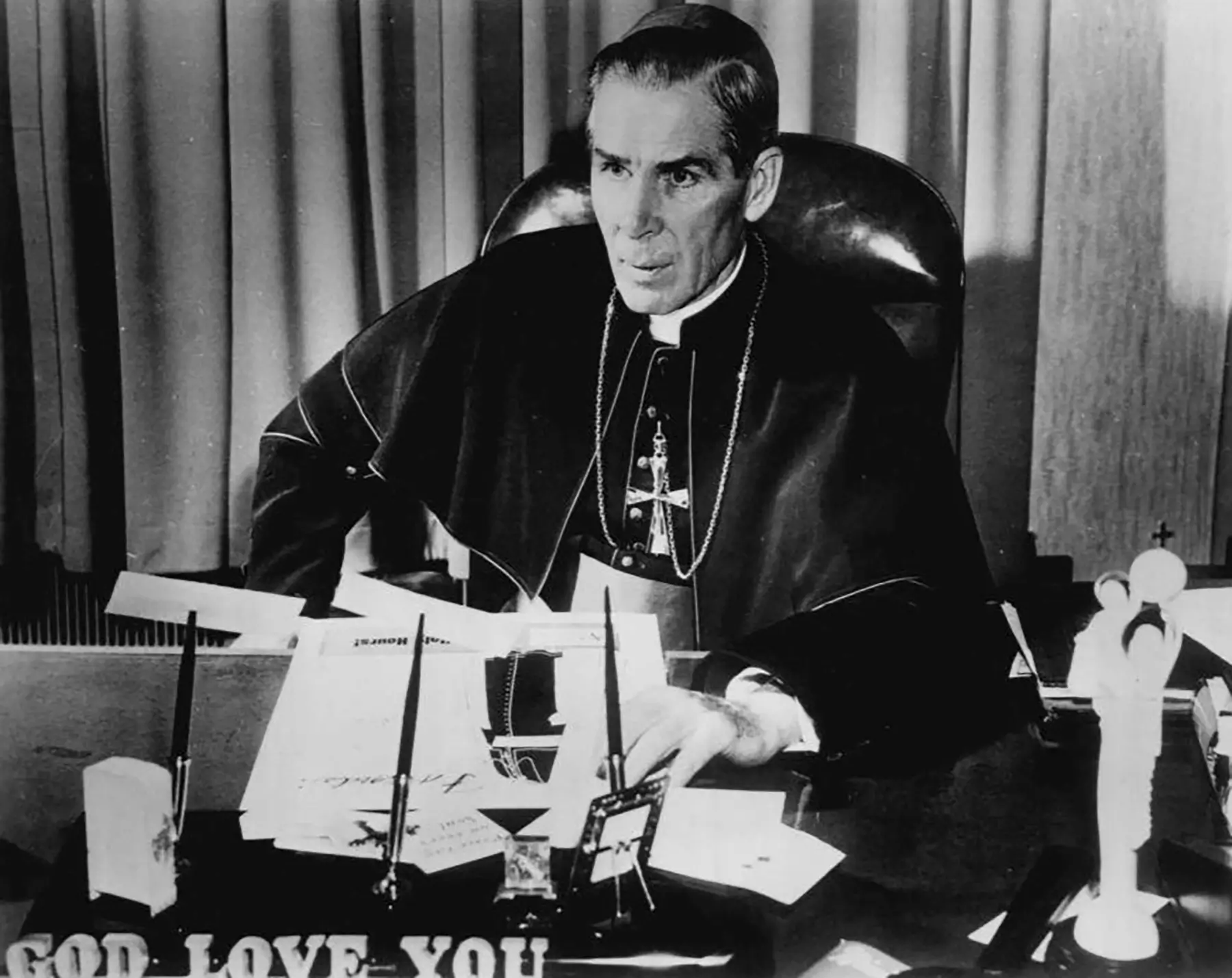
Photo of Bishop Fulton J. Sheen from PICRYL.