The theologian is often tempted to idolize the search for facts and the development of theories. “If only we could think rightly,” goes the faulty rumination, “then we would arrive at bliss and be able to rest upon our contemplation.” This attitude is far from modern, being rebuffed throughout the ages by great saints. Knowledge should not be denigrated, but it is also not meant to be an end in itself.
Avoiding the Idol of the Intellect
In his encyclical Doctor Mellifluus, Venerable Pius XII praises St. Bernard of Clairvaux, a Doctor of the Church, for understanding the proper role of knowledge, noting:
For him, learning is not the final goal, but rather a path leading to God; it is not something cold upon which the mind dwells aimlessly, as though amusing itself under the spell of shifting, brilliant light. Rather, it is moved, impelled, and governed by love. Wherefore, carried upwards by this wisdom and in meditation, contemplation, and love, Bernard climbs the peak of the mystical life and is joined to God Himself (sic), so that at times he enjoyed almost infinite happiness even in this mortal life. (7)
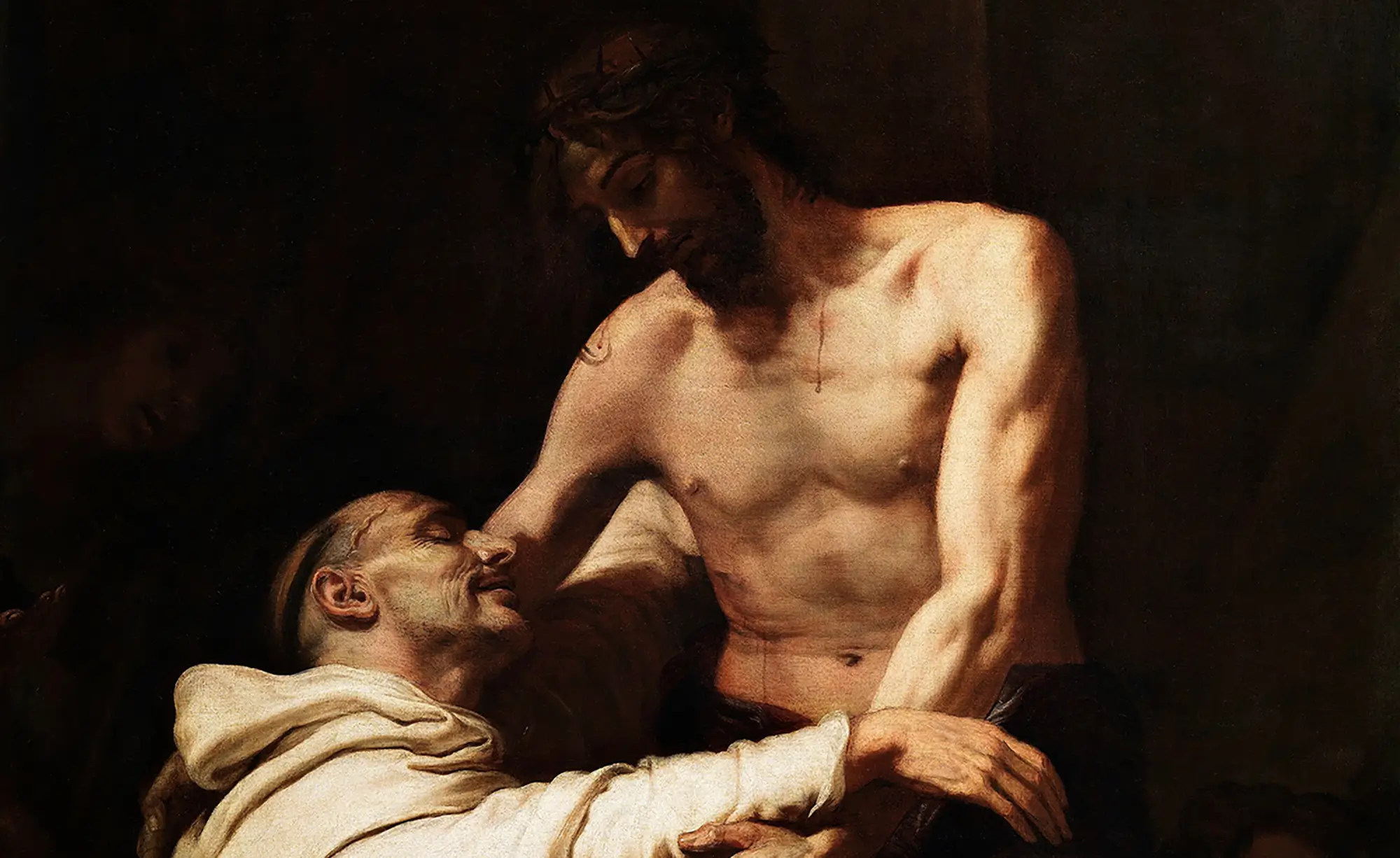
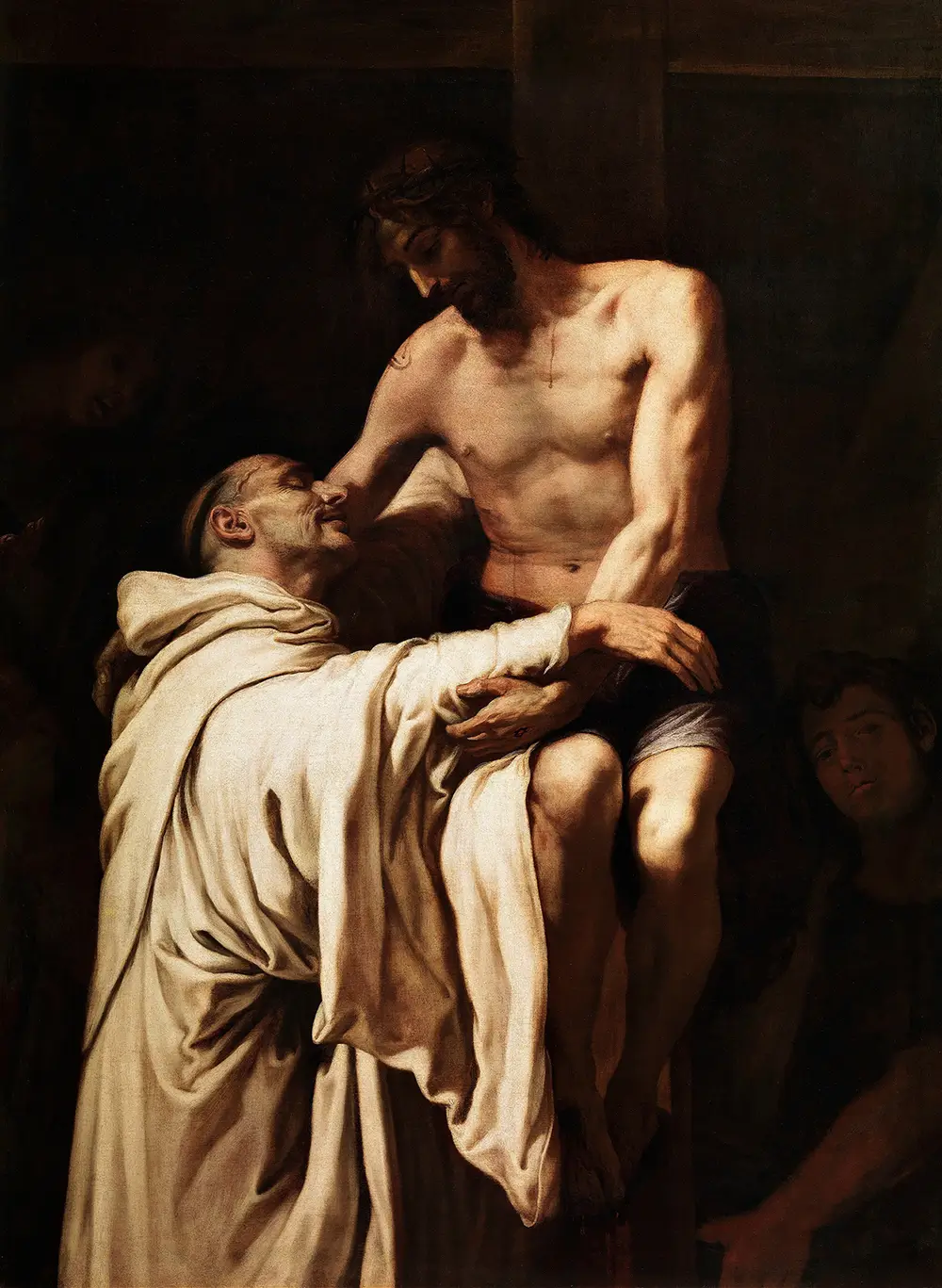
He quotes Bernard himself, who says, “God is Wisdom, and wants to be loved not only affectionately, but also wisely.” (5) Learning then, for St. Bernard, is to be at the service of love and finds its fulfillment in the union of love between God and man. This relationship of illumination and love is expressed profoundly in Francisco Ribalta’s painting titled “Christ Embracing Saint Bernard.”
The Light of the World
The painting depicts an experience had by the saint while praying before a crucifix. Bernarde saw Christ reach down to him from the cross and embrace him in love. Ribalta captures the basic elements of the scene well. Bernard, eyes closed in meditation, is held by Christ who looks on tenderly. But there is much more going on in this rendition.
Much of the painting is shrouded in darkness, with background figures barely visible. Only Bernard and Christ are illuminated, with the light itself shining down from the upper right. It is as though Bernard is literally enlightened by Christ, the light of the world (cf. Jn 1:4-5; 8:12). Ribalta is expressing that, in the life of St. Bernard, wisdom and learning came from the Lord. All else is darkness in comparison.
It is also notable that, within the work, this light of knowledge is not the focal point. It is at the service of depicting the embrace of Christ and Bernard. Far from existing on its own, this depiction of knowledge is at the service of love.
I Who Chose You
Christ is depicted with his eyes open and his arms supporting Bernard. The tension of his left arm demonstrates his strength and activity. Bernard, by contrast, has his eyes closed and is visibly relaxed. Christ is in control and it is he who has initiated this scene. We see this even in the title of the work, “Christ Embracing Saint Bernard.”
This recalls our Lord’s words in the gospel: “You did not choose me, but I chose you” (Jn 15:16). Just as Christ is the one who illuminates Bernard with knowledge, it is Christ who begins this embrace of love. Bernard is not entirely passive, but he only loves because he is loved.
A Cross without a Cross
In being embraced by Christ, Bernard responds with his own embrace. But this embrace reaches out not only to the Lord. As can be seen by the position of Bernard’s left arm, he reaches out to embrace the cross as well. His being loved by Christ leads him to love Christ, and this in turn leads to his love of the cross of Christ.
St. Bernard’s rest in the arms of his Savior sees him with arms outstretched and hanging upon the Lord. It is as though he is crucified on Christ. This recalls St. Paul’s bold proclamation: “I have been crucified with Christ” (Gal 2:20). This mystical crucifixion is not a source of sorrow for Bernard. Rather, he is seen with a restful smile on his face. His embrace of the cross is not an occasion for sorrow, but for joy because it is on that cross that he meets Jesus. All his learning brings him to this place, to love and embrace the “word of the cross... folly to those who are perishing, but to us who are being saved it is the power of God” (1 Cor 1:18).
This is the lesson we may carry forward from Ribalta’s depiction. We meet Christ in our own daily cross, and when that cross is lovingly embraced, we may have the same rest as St. Bernard. As St. Josemaria advised, “Love the Cross. When you really love it, your Cross will be... a Cross, without a Cross.” (Praying the Holy Rosary with St. Josemaria Escriva, 30)

Sam Landon
Sam Landon is an Associate Editor at Midwest Theological Forum. He holds a master’s in religious studies specializing in New Testament and early Christianity from the University of Chicago. He has worked extensively in campus ministry to help young adults grow closer to Christ. He and his wife live in Chicago, IL.

Artwork: Christ Embraces Saint Bernard by Francisco Ribalta