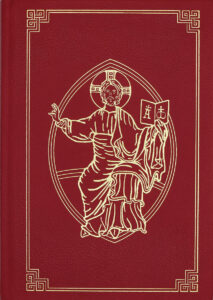
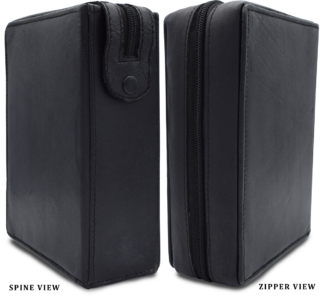
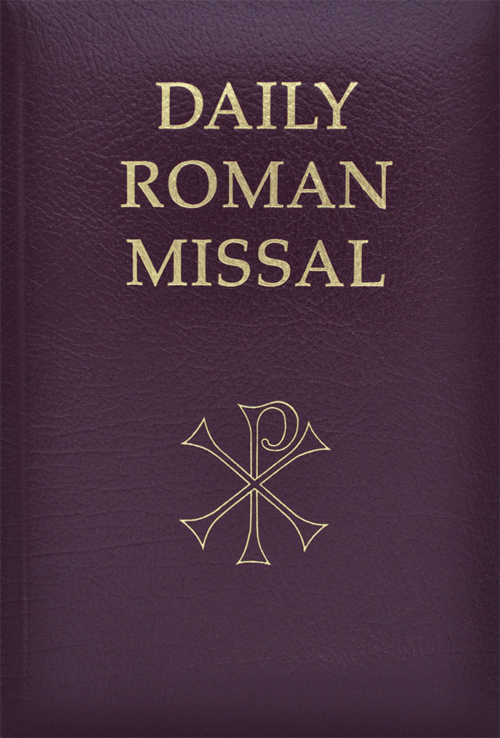
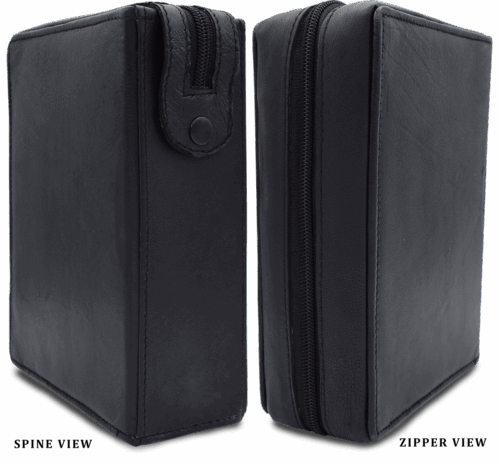
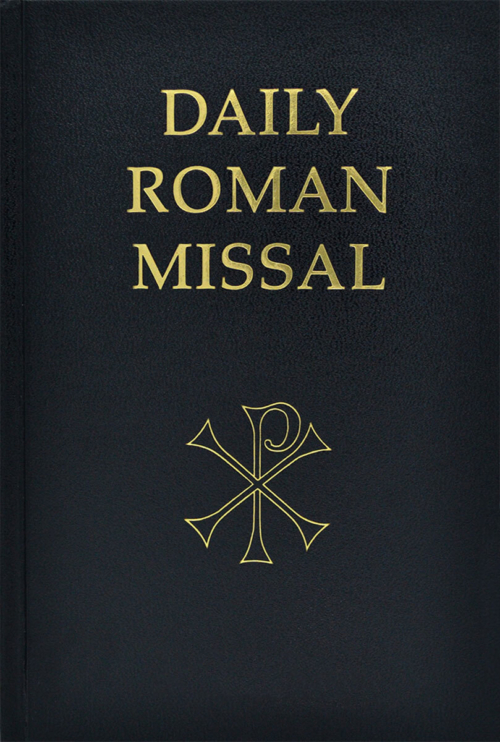
Daily Roman Missal, 7th Ed., Standard Print (Hardcover, Burgundy)

Daily Roman Missal, Hardcover Burgundy
Look Inside


All domestic and international orders are processed Monday through Friday within 24 hours of receipt. Our main shipping providers are UPS and the USPS.  Every order will originate from our lone location in Downers Grove, IL, USA.

Orders can be returned for a credit or refund within 30 days of purchase. No exceptions will be made for returns past 30 days. View more details.

Our staff is available to assist you during regular business hours: Monday - Friday, 9:00am - 4:00pm CT. Please contact us at 630-541-8519 or info@mwtf.org

Se habla español

Daily Roman Missal

How do I know which edition of the Daily Roman Missal I have?
The Daily Roman Missal is available in hardcover (burgundy or black) and leatherbound (burgundy or black). If you are unsure which one you have, the title page will have copyright dates and edition information.
Why is there no Imprimatur for the Daily Roman Missal?
The Committee on pine Worship, a committee of the United States Conference of Catholic Bishops, does not issue an Imprimatur (“permission to publish”) for liturgical publications such as missals, lectionaries, rituals, and books of blessings. Instead, the Committee has issued a Concordat cum Originali, which is an attestation that the texts included in the book faithfully reproduce what are found in the official publications. Since this missal has been granted a Concordat cum Originali, no further permission to publish is necessary (or even possible to obtain).
What sections of the Daily Roman Missal are in both Latin and English?
The Order of Mass—including the Eucharistic Prayers, the Entrance and Communion Antiphons, the response to the Responsorial Psalm, the Sequence, the Alleluia Verse Before the Gospel—and many of the devotions and prayers are in both Latin and English.
Where are the Latin texts of the Prefaces found in the Daily Roman Missal, standard print?
The Prefaces in this edition are in English only; however, we do have an edition with the Latin and English texts of the Prefaces: Large Print Edition with Additional Eucharistic Prayers.
Where are the Prefaces for Eucharistic Prayers I and III? They are not on pages 767 and 791, respectively.
There are no proper Prefaces for these Eucharistic Prayers. Whereas Eucharistic Prayers II and IV have proper Prefaces, I and III do not; this is not something the editors forgot to include or decided to omit. When praying Eucharistic Prayer I or III, use the Preface specified by the rubrics. For example, in Ordinary Time see page 839, no. 5: “[O]n Sundays one of the Prefaces of Sundays in Ordinary Time is said, pp. 745–749; but on weekdays, a Common Preface is said, pp. 758–762.”
Can I use this missal outside the USA, for example, in Canada, England, or Nigeria?
To a limited extent, yes. The Latin texts are universal and the English texts from the missal are copyrighted by the International Commission on English in the Liturgy, which are used throughout the English-speaking world. However, the readings are taken from the New American Bible with Revised New Testament, which is approved for all Masses in the dioceses of the USA; furthermore, the calendar is adapted for use in the dioceses of the USA, so feasts proper to other English-speaking countries are not in this missal.
How can I find the readings for a particular day?
Table I, on pages xxxiv–xxxvii, is a useful guide. For example, let us use Table I to find the prayers and readings on the Sunday of Pentecost 2019. This feast is listed on page xxxv, about 4/5 the way down the table. The header rows of the table inform us this feast in 2019 will use the readings for Year C, and tracing this down to the row labeled “Pentecost” informs us this feast will fall on June 9. Turning to page 689, as indicated to the left of “Pentecost,” we find the beginning of this Mass.
Where can I find the Mass for the Memorial of the Immaculate Heart of the Blessed Virgin Mary?
It is on page 1823. This is a moveable feast, meaning its calendar date is not the same every year. The feasts at the end of Ordinary Time are Feasts of the Lord, which this is not. Therefore, the altar missal and lectionary place it between May and June because most years it is celebrated in June.
Why do some of the Psalms have two numbers and others have only one?
The Psalms are numbered differently in the missal and the lectionary; we have reproduced faithfully what appears in each publication. In the lectionary published by the United States Conference of Catholic Bishops (USCCB) in 1998 and 2002, the Psalms are numbered according to the Hebrew tradition; however, in the altar missal published by the USCCB in 2010, the Psalms are numbered according to the Hebrew tradition with the Greco–Latin tradition acknowledged in brackets. As we have no authority to alter either source when printing our missal, we have reproduced faithfully what appears in each one. The number of a Psalm in the Greco–Latin tradition (Septuagint, Vulgate) is often one less than in the Hebrew tradition. Citing both traditions as the missal does conveys more information but is a more accurate citation.
Why does the “Prayer to Jesus Christ Crucified” list the citation as Psalm 21 when the quote is from Psalm 22?
There are two traditions for numbering the Psalms, and this references the Greco–Latin tradition. The number of a Psalm in the Greco–Latin tradition (Septuagint, Vulgate) is often one less than in the Hebrew tradition. Since this prayer is printed in both Latin and English, the editors thought it would seem more dignified to number it according to just the Greco-Latin tradition rather than the Hebrew as well.
What do the abbreviations “V.” and “R.” mean?
They indicate the leader’s verses and a person’s or the people’s responses. The abbreviation “V.” indicates where the leader of the prayer speaks, and “R.” indicates the response. For example, in the Angelus on page 2299, the first two lines are thus:
V. The angel of the Lord declared unto Mary;
R. And she conceived by the Holy Spirit.
In this example, the leader reads the first line, and everyone else responds with the second line.
Where can I find the Presidential Prayers (Entrance Antiphon, the Prayer over the Offering, and the Communion Antiphon) for the weekdays in Ordinary Time?
The answer begins on page 839. This quoted section of the missal explains what elements from the missal are used during Ordinary Time. Number 3b reads, in part: “On weekdays, however, any of the thirty-four [Sunday] Masses may be used.” Unless there is a feast day, the Entrance and Communion Antiphons are taken from one of the Sunday Masses. There is no way for us to know which antiphons will be chosen, again quoting from number 3b, considering that “the pastoral needs of the faithful are taken into consideration.” The best way to learn this would probably be to ask the celebrant; perhaps he has a pattern, for example, using the previous Sunday’s antiphons. Page xx also includes a helpful guide for Mass on weekdays.
Does this missal include the invocation of St. Joseph in Eucharistic Prayers II, III and IV?
The current printing of the Daily Roman Missal does have the invocation of St. Joseph in Eucharistic Prayers II, III, and IV.
Does the current printing of the Daily Roman Missal omit the word “one” from the ending of the Collect prayer?
Yes. The latest printing reflects the latest translation of the Collect prayer from Latin to English.

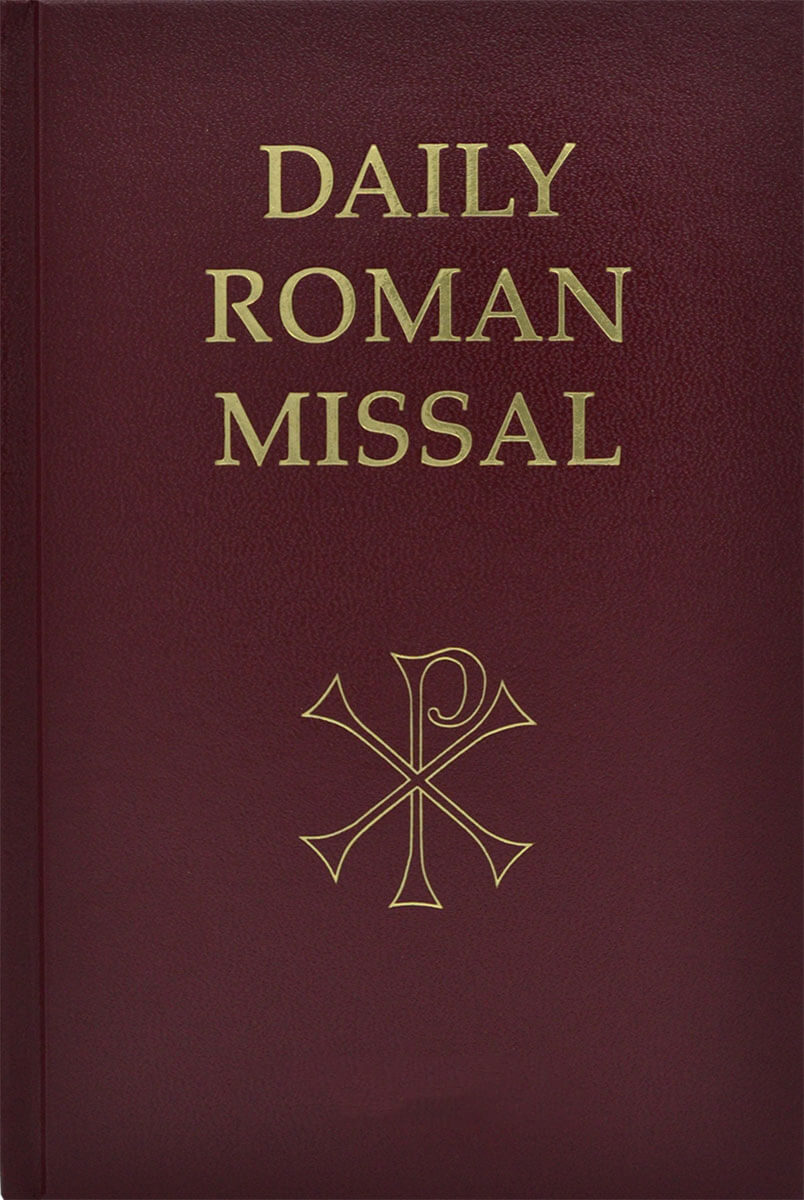
Daily Roman Missal, 7th Ed., Standard Print (Hardcover, Burgundy)

Author: James Socias
Pages: 2558
Size: 4.5 x 6.75
ISBN: 978-1-936045-57-0
Binding: Hardcover

Original price was: $59.95.Current price is: $47.96.

20% Off

In stock

Also available:

Description

Published over 30 years ago, the Daily Roman Missal continues to be an essential resource for following the Holy Mass, studying it more closely, and reflecting on its profound beauty and grace. It familiarizes the faithful with Sacred Scripture, explaining it in the context of their public and communal worship of God. Ideal for traveling as it fits in a glove box, backpack, or carry-on.

Features of the Daily Roman Missal, Seventh Edition:

  • Prayers, antiphons, and readings (A-B-C cycle for Sundays, two-year cycle for weekdays) for all Masses throughout the liturgical year;
  • English and Latin side-by-side texts for the Order of Mass (including Eucharistic Prayers I – IV), the Entrance and Communion Antiphons, the response to Responsorial Psalm, the Sequence, the Alleluia verse, and many devotions and prayers;
  • Masses for all the saints on the General Roman Calendar, adapted for use in the dioceses of the United States of America;
  • Liturgical Calendar, text is 10pt font;
  • Six placeholder ribbons, Smyth-sewn binding provides durability and allows the DRM to lay flat when open.

In addition, over 200 pages of devotions and prayers complete this dignified, one-volume hand missal.

All domestic and international orders are processed Monday through Friday within 24 hours of receipt. Our main shipping providers are UPS and the USPS.  Every order will originate from our lone location in Downers Grove, IL, USA.

Orders can be returned for a credit or refund within 30 days of purchase. No exceptions will be made for returns past 30 days. View more details.

Our staff is available to assist you during regular business hours: Monday - Friday, 9:00am - 4:00pm CT. Please contact us at 630-541-8519 or info@mwtf.org

Se habla español

Daily Roman Missal

How do I know which edition of the Daily Roman Missal I have?
The Daily Roman Missal is available in hardcover (burgundy or black) and leatherbound (burgundy or black). If you are unsure which one you have, the title page will have copyright dates and edition information.
Why is there no Imprimatur for the Daily Roman Missal?
The Committee on pine Worship, a committee of the United States Conference of Catholic Bishops, does not issue an Imprimatur (“permission to publish”) for liturgical publications such as missals, lectionaries, rituals, and books of blessings. Instead, the Committee has issued a Concordat cum Originali, which is an attestation that the texts included in the book faithfully reproduce what are found in the official publications. Since this missal has been granted a Concordat cum Originali, no further permission to publish is necessary (or even possible to obtain).
What sections of the Daily Roman Missal are in both Latin and English?
The Order of Mass—including the Eucharistic Prayers, the Entrance and Communion Antiphons, the response to the Responsorial Psalm, the Sequence, the Alleluia Verse Before the Gospel—and many of the devotions and prayers are in both Latin and English.
Where are the Latin texts of the Prefaces found in the Daily Roman Missal, standard print?
The Prefaces in this edition are in English only; however, we do have an edition with the Latin and English texts of the Prefaces: Large Print Edition with Additional Eucharistic Prayers.
Where are the Prefaces for Eucharistic Prayers I and III? They are not on pages 767 and 791, respectively.
There are no proper Prefaces for these Eucharistic Prayers. Whereas Eucharistic Prayers II and IV have proper Prefaces, I and III do not; this is not something the editors forgot to include or decided to omit. When praying Eucharistic Prayer I or III, use the Preface specified by the rubrics. For example, in Ordinary Time see page 839, no. 5: “[O]n Sundays one of the Prefaces of Sundays in Ordinary Time is said, pp. 745–749; but on weekdays, a Common Preface is said, pp. 758–762.”
Can I use this missal outside the USA, for example, in Canada, England, or Nigeria?
To a limited extent, yes. The Latin texts are universal and the English texts from the missal are copyrighted by the International Commission on English in the Liturgy, which are used throughout the English-speaking world. However, the readings are taken from the New American Bible with Revised New Testament, which is approved for all Masses in the dioceses of the USA; furthermore, the calendar is adapted for use in the dioceses of the USA, so feasts proper to other English-speaking countries are not in this missal.
How can I find the readings for a particular day?
Table I, on pages xxxiv–xxxvii, is a useful guide. For example, let us use Table I to find the prayers and readings on the Sunday of Pentecost 2019. This feast is listed on page xxxv, about 4/5 the way down the table. The header rows of the table inform us this feast in 2019 will use the readings for Year C, and tracing this down to the row labeled “Pentecost” informs us this feast will fall on June 9. Turning to page 689, as indicated to the left of “Pentecost,” we find the beginning of this Mass.
Where can I find the Mass for the Memorial of the Immaculate Heart of the Blessed Virgin Mary?
It is on page 1823. This is a moveable feast, meaning its calendar date is not the same every year. The feasts at the end of Ordinary Time are Feasts of the Lord, which this is not. Therefore, the altar missal and lectionary place it between May and June because most years it is celebrated in June.
Why do some of the Psalms have two numbers and others have only one?
The Psalms are numbered differently in the missal and the lectionary; we have reproduced faithfully what appears in each publication. In the lectionary published by the United States Conference of Catholic Bishops (USCCB) in 1998 and 2002, the Psalms are numbered according to the Hebrew tradition; however, in the altar missal published by the USCCB in 2010, the Psalms are numbered according to the Hebrew tradition with the Greco–Latin tradition acknowledged in brackets. As we have no authority to alter either source when printing our missal, we have reproduced faithfully what appears in each one. The number of a Psalm in the Greco–Latin tradition (Septuagint, Vulgate) is often one less than in the Hebrew tradition. Citing both traditions as the missal does conveys more information but is a more accurate citation.
Why does the “Prayer to Jesus Christ Crucified” list the citation as Psalm 21 when the quote is from Psalm 22?
There are two traditions for numbering the Psalms, and this references the Greco–Latin tradition. The number of a Psalm in the Greco–Latin tradition (Septuagint, Vulgate) is often one less than in the Hebrew tradition. Since this prayer is printed in both Latin and English, the editors thought it would seem more dignified to number it according to just the Greco-Latin tradition rather than the Hebrew as well.
What do the abbreviations “V.” and “R.” mean?
They indicate the leader’s verses and a person’s or the people’s responses. The abbreviation “V.” indicates where the leader of the prayer speaks, and “R.” indicates the response. For example, in the Angelus on page 2299, the first two lines are thus:
V. The angel of the Lord declared unto Mary;
R. And she conceived by the Holy Spirit.
In this example, the leader reads the first line, and everyone else responds with the second line.
Where can I find the Presidential Prayers (Entrance Antiphon, the Prayer over the Offering, and the Communion Antiphon) for the weekdays in Ordinary Time?
The answer begins on page 839. This quoted section of the missal explains what elements from the missal are used during Ordinary Time. Number 3b reads, in part: “On weekdays, however, any of the thirty-four [Sunday] Masses may be used.” Unless there is a feast day, the Entrance and Communion Antiphons are taken from one of the Sunday Masses. There is no way for us to know which antiphons will be chosen, again quoting from number 3b, considering that “the pastoral needs of the faithful are taken into consideration.” The best way to learn this would probably be to ask the celebrant; perhaps he has a pattern, for example, using the previous Sunday’s antiphons. Page xx also includes a helpful guide for Mass on weekdays.
Does this missal include the invocation of St. Joseph in Eucharistic Prayers II, III and IV?
The current printing of the Daily Roman Missal does have the invocation of St. Joseph in Eucharistic Prayers II, III, and IV.
Does the current printing of the Daily Roman Missal omit the word “one” from the ending of the Collect prayer?
Yes. The latest printing reflects the latest translation of the Collect prayer from Latin to English.