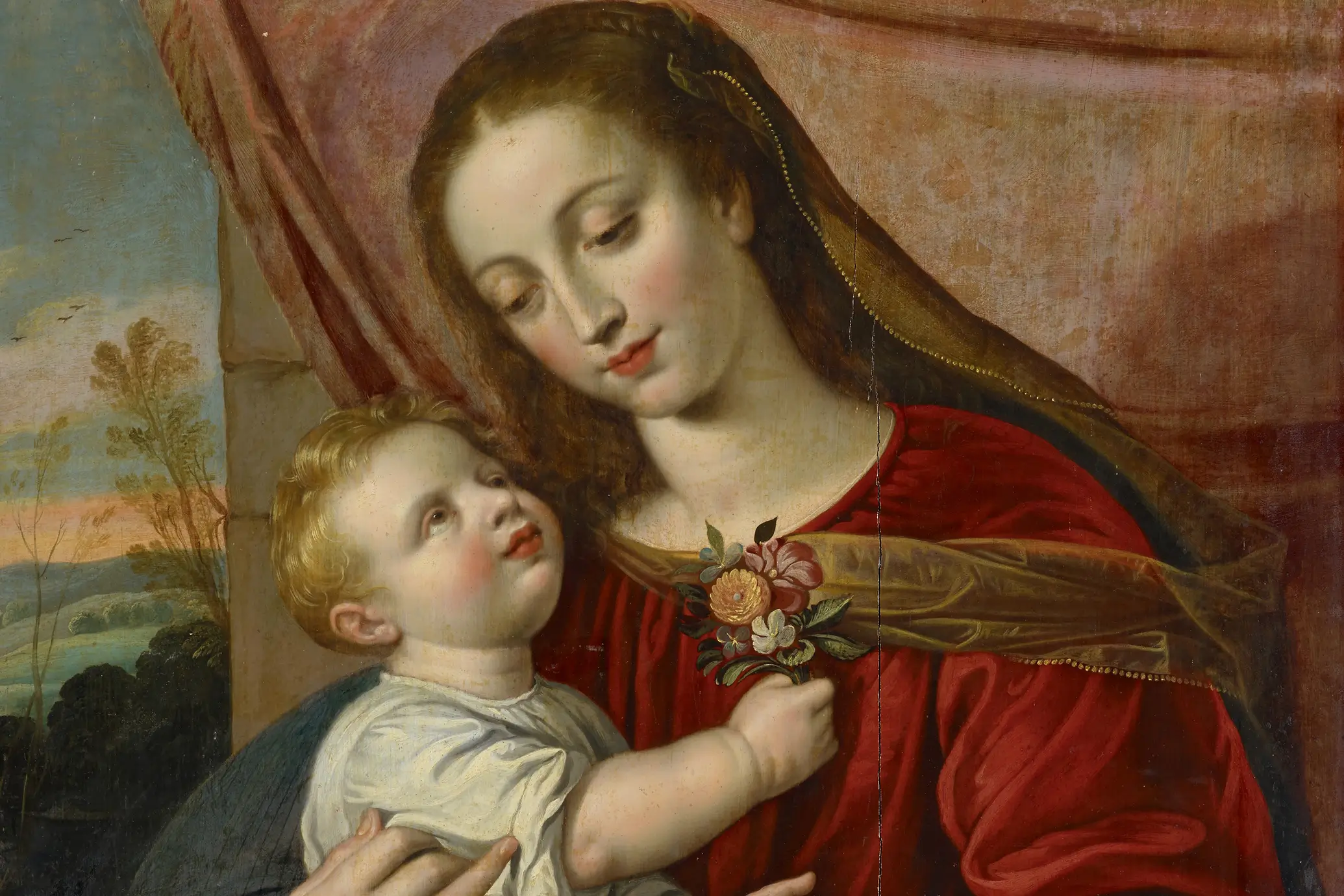
May has come. Nature grows verdant. Trees are budding. Birds chirrup by the dozens. The month emerges with its own beauty and warmth. In popular piety, too, May is crowned with beauty, as the whole month is devoted to Mary. This complements the liturgical season of Easter and the feast of Pentecost.
50 days after that fateful Passover, Mary—together with the apostles and other disciples—was present when the Holy Spirit descended on the infant Church. From that point on, the Church witnessed an influx of converts due to the influence of God’s outpouring of grace.
Mary as Mother
In those early years, the Virgin Mary was physically present among the faithful. But like her spouse St. Joseph before her, little is heard from her in the Scriptures following the Resurrection. Nevertheless, we can safely assume that she did what she does now—and what any mother does for her children: She guided the faithful, prayed for them, instructed, and interceded. As the New Eve, she became the Mother of all those brought to new life in Christ.
In the creation account of Genesis chapter 2, God is not finished with his work until he makes for Adam a helpmate who complements and completes his nature. Thus, Eve crowns or completes the initial creation ordered by God (cf. Gen 2:23).
The Blessed Virgin Mary, the New Eve, is one of the crowning glories of the new creation. At the end of her earthly pilgrimage, she was taken body and soul into the courts of paradise. Mary, whom our Lord Jesus gave to us through the Apostle John to be our Mother also (cf. Jn 19:26–27), does not suffer bodily corruption. We have a loving Mother who dies no more. Like her Son, she lives forever. And plentiful Marian apparitions prove her ever-present care and concern for her children.
What We Have in Common with Jesus
All the saints love Mary; many have expressed as much. The fact that the Blessed Virgin is our affectionate Mother demonstrates something of our dignity as human beings and as Christians. Through the Incarnation, we now not only bear God’s likeness but actually share something in common with God himself. In becoming man, Jesus joins himself to his creation. More specifically, he joins himself to a human nature, our nature. As if that was not enough, Jesus desires to share still more with us. Our Lord gave us his own Mother, further strengthening the intimate, familial bond between himself and the faithful.
On the grand stage of salvation history, Mary will always be Theotokos, the God-bearer. In a more immediate sense, she is also “Mother” to you and me. A mother’s role is sheer love, and her heart is fashioned for and bent to this task, this high calling of selflessness.
In one Gospel account, when a woman listening to Jesus cries out, “Blessed is the womb that bore you, and the breasts that you sucked,” our Lord replied that real righteousness comes from hearing and obeying God (cf. Lk 11:27–28). Jesus was in no way dissing Mary. He actually disclosed what made her truly great.
Jesus shifts the attention from the biologically maternal actions of Mary to the virtue with which she did them. This highlights the supremacy of intentionality over busyness. Anyone can perform an action, but what is the heartfelt motivation? Jesus is concerned with how people live their lives. Mary has lived hers according to God’s Will.
The Beauty of Motherhood
Mary lives out the virtues required in her role as mother. All of us, God’s daughters and sons, can imitate the Immaculate. Mary remained morally spotless and pure throughout her earthly existence and now dwells in heavenly glory. Holiness is spiritual beauty. With this in mind, it is no wonder Mary has been called the tota pulchra, the all-beautiful, or “wholly fair woman.”
The Catholic philologist and author of The Lord of the Rings, J.R.R. Tolkien, once told a priest-friend of his that “Our Lady” was the model “upon which all my own small perception of beauty both in majesty and simplicity is founded.”
Could the same be said of us? In the way of spiritual beauty (holiness of the soul), we really would do well to pattern our lives after the Blessed Mother’s. As the Mother of a Man, she sought Jesus’ wellbeing. As the Mother of God, she sought to do his Will. Her life is a perfect summation of the two chief commandments to love God and to love our neighbors (cf. Mt 22:37–40). That is what we all are called to do. But moms do it in a particular fashion specific to their station in life.
Our Shared Calling
Following the vocation to marriage, many couples are blessed with the further vocation and responsibility of raising children. This takes a certain toll particularly on a mother, who carries her unborn child for an extended period within her womb. She is, in a sense, the first parent and feels the effects of parenthood sooner than the father. There is a biological and spiritual closeness shared between baby and mom.
For her part, mom also starts caring for the child even before she has been born. A good mother, once she knows she is pregnant, pays close attention to things that can affect her baby, like her various activities and the foods she eats. This requires genuine agape, or selfless, God-like love.
The medieval mystic Julian of Norwich drew a comparison between a mother nursing her infant and Jesus sustaining us with his Body and Blood in the Eucharist. Both give totally of themselves. Both sustain life through their bodies. Both require a loving sacrifice.
We might not all be able to nurse a child, but all of us are able to make sacrifices for the good of others out of love for God. Once again, we are at the intersection of the two great commandments. The universal call to holiness, the vocation common to all, is self-sacrificial love. Jesus had it. So did Mary. Let us pray we can also grow in offering ourselves through love.
This Mother’s Day, let us acknowledge the sacrifices our mothers made for us—including the sorrows Mary faced at the foot of the Cross for our eternal benefit—and respond with gratitude, appreciation, and prayer.
Artwork: The Virgin with Child by Maarten Pepyn